
Aobo Steel | Global Tool Steel Supplier in China
Explore Our Hot-Work Tool Steels for Thermal Stability and Long Die Life
Discover premium hot-work tool steels including H10, H11, H13, H21, and L6. Our steels are optimized for thermal fatigue resistance, balanced toughness, and reliable performance in hot-work tooling applications, with controlled microstructure to ensure consistent heat treatment results and extended die life.
✓100% UT Tested Quality Assurance
✓SEP 1921-82 Class D/d Guaranteed
✓Annealed State Delivery
✓Surface: Black Scale, Turned, Mill Finish, or Polished
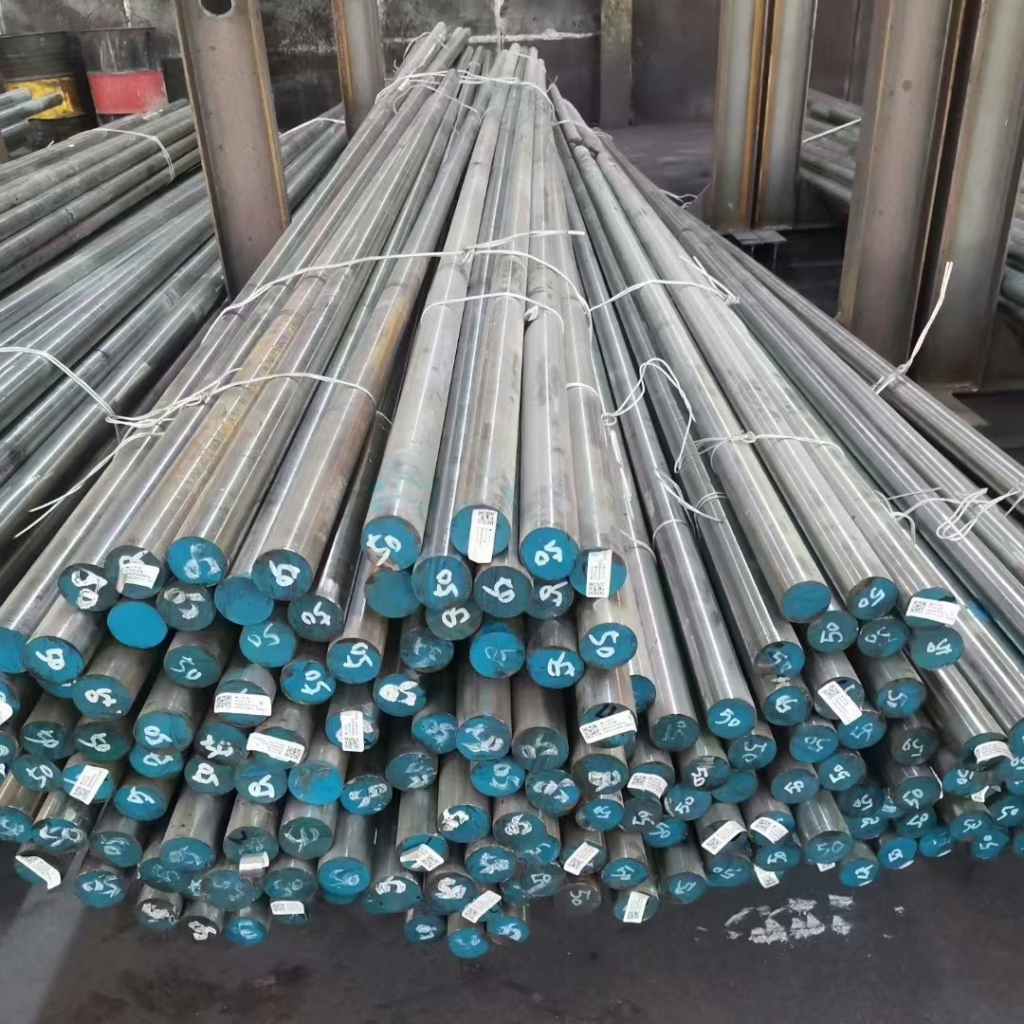
H10 Tool Steel | 1.2365 | SKD7
H10 is a chromium-molybdenum steel characterized by high hardenability and resistance to softening at elevated temperatures. This steel exhibits high toughness and excellent thermal fatigue resistance, and can be water-quenched during processing. H10 is widely used in demanding applications, such as hot extrusion dies, aluminum die-casting molds, and hot shearing equipment.
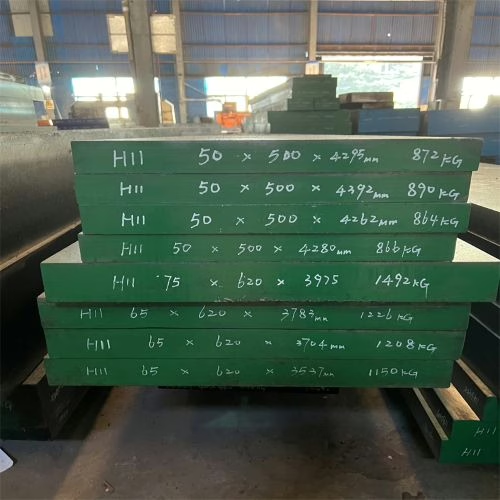
H11 Tool Steel | 1.2343 | SKD6
H11 is a 5% chromium-based steel offering deep hardenability, high ductility, and toughness. This steel exhibits excellent resistance to thermal shock and hot cracking, permitting water quenching. It is suitable for demanding hot-work applications, such as aluminum die-casting molds, hot-extrusion tools, and high-strength aerospace components.
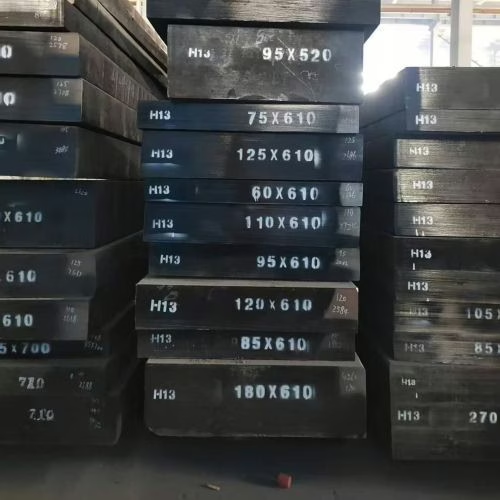
H13 TOOL STEEL | 1.2344 | SKD61
H13 has a higher vanadium content than H11, offering exceptional wear resistance and high-temperature strength. This steel exhibits outstanding resistance to thermal fatigue and thermal cracking, making it the industry-standard material for inserts in aluminum die casting, magnesium extrusion, and high-heat-stress heavy forging dies.
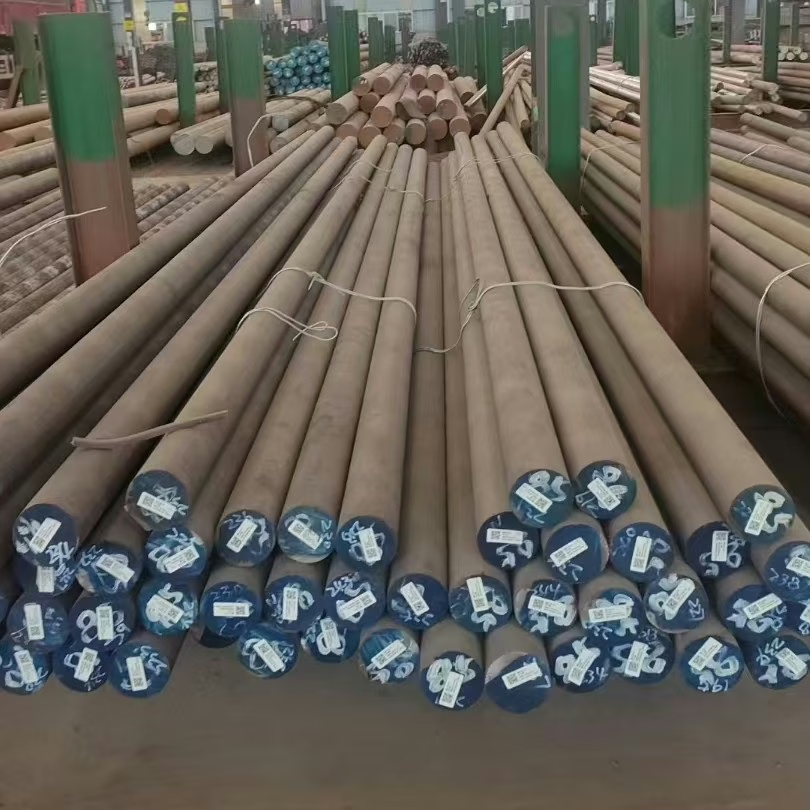
H21 Tool Steel | 1.2581 | SKD7
H21 is a tungsten alloy steel offering exceptional high-temperature red hardness and wear resistance. While its toughness is lower than that of chromium-based steels, it exhibits strong resistance to softening and erosion. It is the preferred material for hot extrusion dies for brass and steel, hot punches, and high-temperature casting dies.
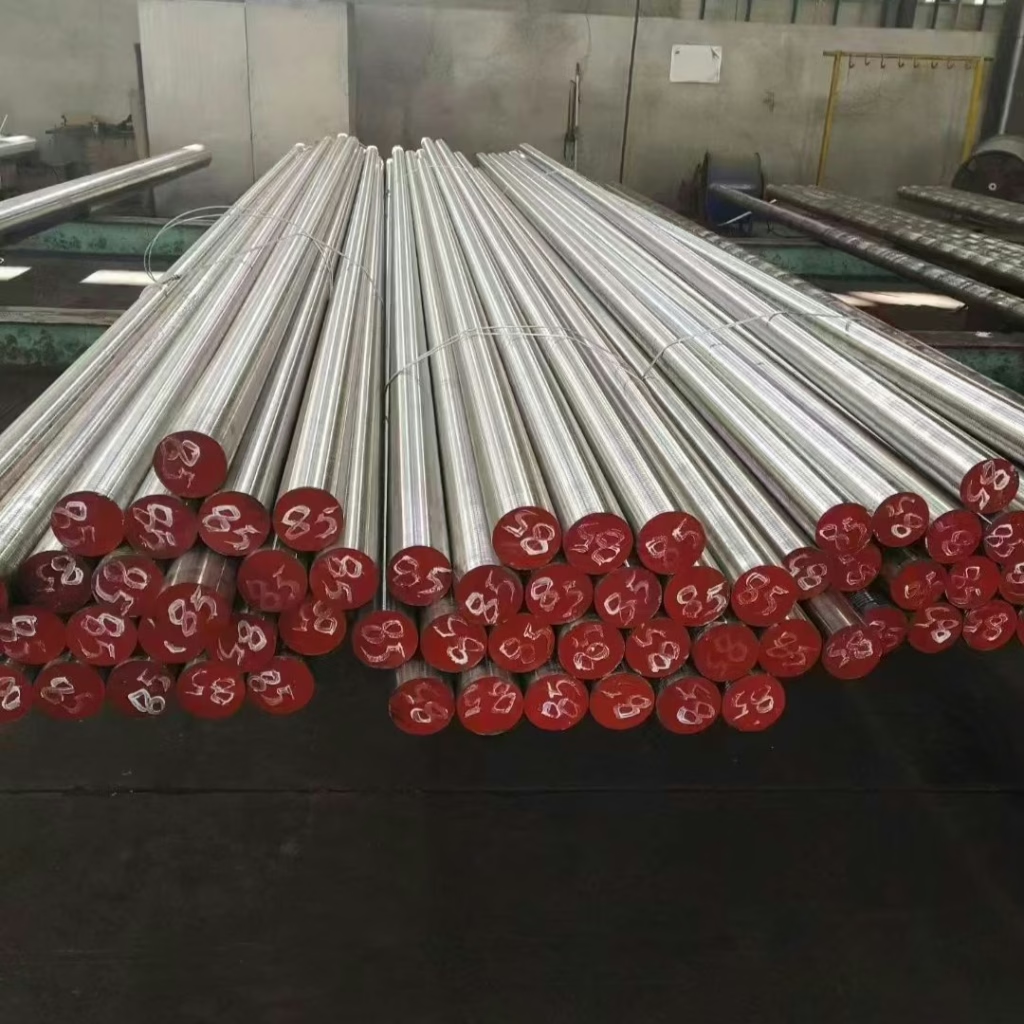
L6 Tool Steel | 1.2714 | SKT4
L6 is a nickel-chromium oil-hardenable steel that combines exceptional toughness with excellent hardenability and wear resistance. This steel exhibits outstanding resistance to impact loads and is suitable for heavy-duty tools requiring deep hardening. It is commonly used in drop-forging dies, heavy-duty shearing blades, forming rolls, and mechanical components.
What is Hot Work Tool Steel?
Hot work tool steel is an H-series steel defined by the American Iron and Steel Institute (AISI), specifically engineered to withstand high temperatures, high pressures, and repeated thermal cycling. Cold work tool steel typically operates below 200°C (390°F), and its performance significantly deteriorates once temperatures exceed this threshold. Hot work tool steel, however, is engineered for high-temperature environments ranging from 315°C to 650°C (600°F to 1200°F). Within this temperature range, hot work tool steel not only maintains exceptional strength but also exhibits outstanding toughness. This enables effective resistance to thermal fatigue, ensuring molds remain crack-free and distortion-free throughout extended service life.
Hot work tool steel is typically a medium-carbon iron-based alloy containing high concentrations of alloying elements such as chromium (Cr), tungsten (W), molybdenum (Mo), and vanadium (V), with total alloy content generally ranging from 6% to 25%. Based on their primary alloying elements, H-series products are categorized into three main groups: H10-H19 series chromium-based hot work steels; H21-H26 series tungsten-based hot work steels; and H42-H43 series molybdenum-based hot work steels.
Composition and Alloying Elements
Hot-work tool steels typically have a medium carbon content, usually 0.35% to 0.45%. This lower carbon content, compared to that of cold-worked steels, promotes higher toughness. Their resistance to softening at elevated temperatures is achieved by alloying elements such as chromium, tungsten, molybdenum, and vanadium, which collectively range from 6% to 25% of the composition.
- Chromium (Cr): A primary alloying element, typically 3% to 5%, contributes to hot hardness, wear resistance, and improves hardenability and oxidation resistance.
- Tungsten (W): Provides resistance to softening at high temperatures (red hardness) and wear resistance by forming stable carbides. It also contributes to hot hardness and can be present in substantial amounts (e.g., 9% to 19%) in tungsten-base hot work steels. However, a high tungsten content can reduce toughness and thermal shock resistance, making them unsuitable for water cooling during operation.
- Molybdenum (Mo): Similar to tungsten, it is crucial for hot hardness, increased resistance to tempering, and forms wear-resistant carbides. Molybdenum has about twice the effect on hot hardness as tungsten.
- Vanadium (V): Forms very hard carbides (MC type) that significantly increase wear resistance and hot hardness.
- Cobalt (Co): When added, it primarily increases hot hardness, enhancing cutting efficiency at high tool temperatures. Cobalt-containing steels generally exhibit higher hot hardness.
Properties
- Hot Hardness (Red Hardness). This is the most important property, referring to the ability to maintain hardness at elevated temperatures, often up to 650°C (1200°F) or higher for brief periods.
- Wear Resistance. Hot work tools are subjected to abrasive action from hot metals and require resistance to wear, including erosive wear (washing) at high temperatures.
- Toughness. This is the ability to resist chipping, breaking, and crack propagation under mechanical and thermal shock. Toughness is often balanced against hardness and wear resistance, as increasing one may decrease the other.
- Resistance to Thermal Fatigue (Heat Checking). This refers to the ability to withstand repeated cycles of rapid heating and cooling without forming a network of fine cracks on the tool surface. Heat checking is a common failure mode in die-casting dies.
- High-Temperature Strength. The capacity to withstand sustained loads at elevated temperatures without undergoing plastic deformation.
- Hardenability. Hot work steels are designed for deep hardening, often by air cooling, which helps minimize distortion during heat treatment.
Classification
Here, we classify according to the American AISI standard(AISI H-Series). Hot work tool steels are primarily classified under the AISI H-series. They are subdivided into three main groups based on their principal alloying elements:
- Chromium Hot-Work Steels (H10-H19): These are the most widely used, especially H11, H12, and H13. They offer a good balance of properties, including excellent toughness and shock resistance, good heat-softening resistance, and high hardenability. They are characterized by low distortion during hardening and can often be water-cooled in service without cracking.
- Tungsten Hot-Work Steels (H21-H26): Known for their very high resistance to high-temperature softening and washing due to high tungsten content. However, they generally have lower toughness and are more susceptible to brittle fracture and thermal shock, making rapid water cooling in service risky.
- Molybdenum Hot-Work Steels (H42, H43): These steels are similar in characteristics and uses to tungsten hot-work steels, offering comparable resistance to softening at elevated temperatures. They are generally more resistant to heat checking than tungsten types but require careful heat treatment to avoid decarburization.
Heat Treatment
Heat treatment is critical in determining the properties of hot-work tool steels. Unlike cold-work dies, hot-work tools operate under cyclic thermal stresses and must be designed to avoid thermal fatigue and plastic deformation. The heat treatment process for hot-work tool steels typically involves four steps: preheating, austenitizing, quenching, and tempering.
Preheating. To prevent thermal shock or deformation in low-thermal-conductivity tool steels caused by rapid heating, standard processes employ multi-stage step heating: Stage 1 at 650°C; Stage 2 at 815–870°C. Each stage requires holding until thermal equilibrium is achieved across the cross-section to eliminate temperature differentials between the interior and exterior. This approach not only reduces thermal stress but also shortens the high-temperature austenitizing time, effectively suppressing material oxidation and decarburization.
Austenitizing is heating steel to 1000–1150°C to transform the microstructure and dissolve carbides. To prevent decarburization or carburization, this process must be conducted under controlled atmospheres such as a vacuum or protective gas. Decarburization creates softened layers that become sources of thermal fatigue cracks due to differential thermal expansion, while carburization leads to brittle chipping.
Quenching is a process that transforms austenite into martensite to achieve high strength. The cooling rate for quenching hot-work tool steel must be sufficiently rapid to avoid the pearlite or bainite transformation zone, yet moderate enough to control thermal deformation. Typically, a multi-stage quenching process is employed, involving cooling to a temperature slightly above the Ms point (260–400°C), holding at that temperature until uniform temperature distribution is achieved throughout the cross-section, and then air cooling. This method not only avoids the severe stress and cracking risks associated with direct cooling but also effectively prevents carbide precipitation at grain boundaries caused by excessively slow cooling, thereby preventing quenching brittleness. Consequently, it ensures impact toughness while achieving an ideal martensitic matrix.
Tempering relieves quenching stresses and produces a tough microstructure, serving as the core process for hot-work tool steels to attain secondary hardening and red hardness. Hot-work tool steel precipitates dispersed carbides during tempering at 500–650°C, thereby maintaining high-temperature strength. Since the cooling process following the initial tempering transforms retained austenite into extremely brittle untempered martensite, dual tempering or even triple tempering is recommended. Multiple tempering cycles eliminate the stress and brittleness of newly formed martensite, preventing dimensional instability or brittle fracture during service.
Applications
Hot-work tool steels are widely used in manufacturing operations that involve the shaping, forming, or cutting of materials at high temperatures. Common applications include:
- Hot Forging Dies: For steel forgings, aluminum, and magnesium.
- Extrusion Dies: For aluminum, magnesium, brass, and steel.
- Die Casting Dies: For aluminum, zinc, and magnesium, and for brass.
- Hot Shear Blades: For cutting heated materials.
- Hot-rolling mill rolls: For medium to long runs and special materials at high temperatures.
- Plastic Injection Molds: Where operating temperatures can reach up to 250°C (480°F).
- Other tools: Mandrels, punches, and piercer points for hot work applications.
Distinction from Other Tool Steels
- Vs. Cold Work Tool Steels: Hot work steels are designed for temperatures above 200°C (390°F), whereas cold work tool steels are for applications typically below 200°C (390°F), often at room temperature. Hot-work steels generally have lower carbon content, and their final hardness is usually determined by desired toughness rather than maximum wear resistance (40-50 HRC vs. ~60 HRC for cold-work steels). Using cold-worked steels for hot applications can lead to annealing or thermal shock-induced cracking.
- Vs. High-Speed Tool Steels (HSS): While high-speed steels also exhibit excellent hot hardness (retaining a keen cutting edge up to 650°C/1200°F or higher), they are primarily developed for metal-cutting operations at high speeds. Hot-work steels are tailored explicitly for forming and shaping applications, offering a balance of hot hardness, toughness, and thermal fatigue resistance. High-speed steels often have higher wear resistance and hot hardness but may have lower toughness than many hot-work steels.
FAQ
Hot-work tool steels are a class of alloy steels designed to resist softening at elevated temperatures, typically used for metal-forming processes in which the tools themselves reach temperatures between 315 and 650 °C (600 and 1200 °F).
There is no single “best” steel; selection depends on balancing hot hardness (resistance to softening), toughness (resistance to breakage), and wear resistance for the specific application.
Tool steels are categorized into various groups based on their composition, application, or heat treatment, including High-Speed (M and T series), Hot-Work (H series), Cold-Work (A, D, O series), Shock-Resisting (S series), Low-Alloy Special-Purpose (L series), Low-Carbon Mold (P series), and Water-Hardening (W series) tool steels.
Grinding itself generates significant heat at the workpiece surface, which can affect surface properties and cause residual stresses. While grinding involves heat, it differs from bulk hot-working processes such as forging or rolling, in which the entire workpiece is heated to a plastic state for deformation.
Hot work tool steels are used for applications where the tool’s operating temperature exceeds 200°C (390°F), requiring resistance to softening, thermal fatigue, and high-temperature wear. Cold-work tool steels are used for operations below 200°C (390°F) and primarily require high hardness, wear resistance, and toughness at room temperature.
Common grades include chromium-base steels (H10, H11, H12, H13, H14, H19), tungsten-base steels (H21, H22, H23, H24, H25, H26), and molybdenum hot-work steel (H42).
Disadvantages can include surface oxidation and scale formation, difficulties in dimensional control due to non-uniform contraction during cooling, potential for grain growth or degradation of properties at excessively high temperatures, and shorter tool life due to heating and abrasive scales108….
Cold work tool steels are used for tooling operations where the working temperature is generally below 200°C (390°F), typically at room temperature. They are selected for their high hardness, good toughness, and high resistance to wear under shock, pressure, or abrasion.
It’s called tool steel because these alloys are specifically designed and processed (often with special heat treatments like hardening and tempering) to manufacture tools, dies, and molds that cut, shape, or form other materials, including metals, plastics, wood, and concrete, under severe service conditions.