

Home > Tool Steel Heat Treatment Technical Center > H10 Tool Steel Heat Treatment Guide
Aobo Steel | Global Tool Steel Supplier in China
H10 Tool Steel Heat Treatment Guide
Practical heat treatment guidance for H10 tool steel to improve thermal shock resistance and toughness in demanding hot-work die applications.
H10 hot-work tool steel is a chromium-molybdenum-vanadium alloy steel characterized by high-temperature resistance to softening and high toughness. It is widely used in die-casting molds, forging dies, and extrusion tools where high pressure and thermal fatigue are encountered. The H10 steel supplied by our company, Aobo Steel, is in the annealed condition, featuring a microstructure composed of a ferritic matrix and spheroidized carbides. This condition exhibits low hardness, which facilitates machining for our customers. We also offer electroslag remelted (ESR) H10, featuring higher purity and a more uniform microstructure, thereby significantly extending its service life.
However, the ultimate realization of H10’s superior performance relies on subsequent hardening heat treatment, which transforms the soft annealed matrix into a hardened martensitic structure after tempering.
This heat treatment process primarily includes: stress relief, preheating, austenitization, quenching, and tempering. This paper will discuss these critical steps.
A Quick Checklist for H10 Tool Steel Heat Treatment
Time needed: 1 day
Perform hardening heat treatment to transform the soft annealed matrix of H10 tool steel into a hardened martensitic structure.
- Stress Relief Heat uniformly to 650°C to 675°C (1200°F to 1250°F) and hold for 1 hour per inch of thickness (minimum 1 hour). Cool slowly in the air.
- Preheating Heat to approximately 650°C (1200°F) for the initial preheat, then heat to 845–870°C (1555–1600°F) for a second preheat if using salt baths or processing complex geometries.
- Austenitizing Heat to 1010°C to 1040°C (1850°F to 1900°F) in a controlled atmosphere (salt bath, inert atmosphere, or vacuum furnace), then hold for 15 to 40 minutes.
- Quenching Cool rapidly using air, an inert gas, or a graded oil/salt bath (maintain oil/salt at 595–650°C / 1105–1200°F) until the workpiece reaches 50-66°C (120-150°F).
- Tempering Heat slowly to a temperature between 400°C and 650°C (750°F – 1200°F) immediately after quenching, and hold for a minimum of 2 hours per inch of thickness in two separate cycles.
Stress Relief Heat Treatment
Machining and forming operations generate residual stresses within H10 tool steel. If these stresses are not relieved prior to subsequent hardening heat treatment, their release can easily cause severe deformation or warping of H10 workpieces. Stress relief treatment does not alter the existing microstructure of H10 material.
During the specific operation, the H10 workpiece must be uniformly heated to 650°C to 675°C (1200°F to 1250°F). The holding time is typically calculated as 1 hour per inch of thickness of the H10 workpiece’s cross-section, with a minimum holding time of 1 hour. The workpiece is then slowly cooled in air.
Preheating Before Austenitizing
Preheating minimizes the risk of deformation and cracking in H10 tool steel caused by temperature differentials. In practice, the H10 workpiece is first heated to approximately 650°C (1200°F) for the initial preheat.
Subsequently, for H10 components undergoing high-temperature salt bath treatment or featuring complex cross-sectional geometries, a second preheat at 845–870°C (1555–1600°F) is recommended. This staged heating approach effectively mitigates thermal shock to H10 components before entering the austenitizing stage, thereby ensuring the structural integrity and dimensional stability of the H10 tool steel.
Austenitizing
After preheating is complete, the H10 steel must be heated to the austenitizing temperature. The austenitizing temperature for H10 steel ranges from 1010°C to 1040°C (1850°F to 1900°F). Strict control of the furnace atmosphere is essential to prevent surface decarburization of H10. It is recommended to use molten-salt baths, inert atmospheres, or vacuum furnaces for surface protection. Once the entire workpiece reaches the preset temperature, it should be held for 15 to 40 minutes. Particular attention must be paid to controlling holding time to avoid excessive grain growth in the microstructure from prolonged exposure.
Quenching
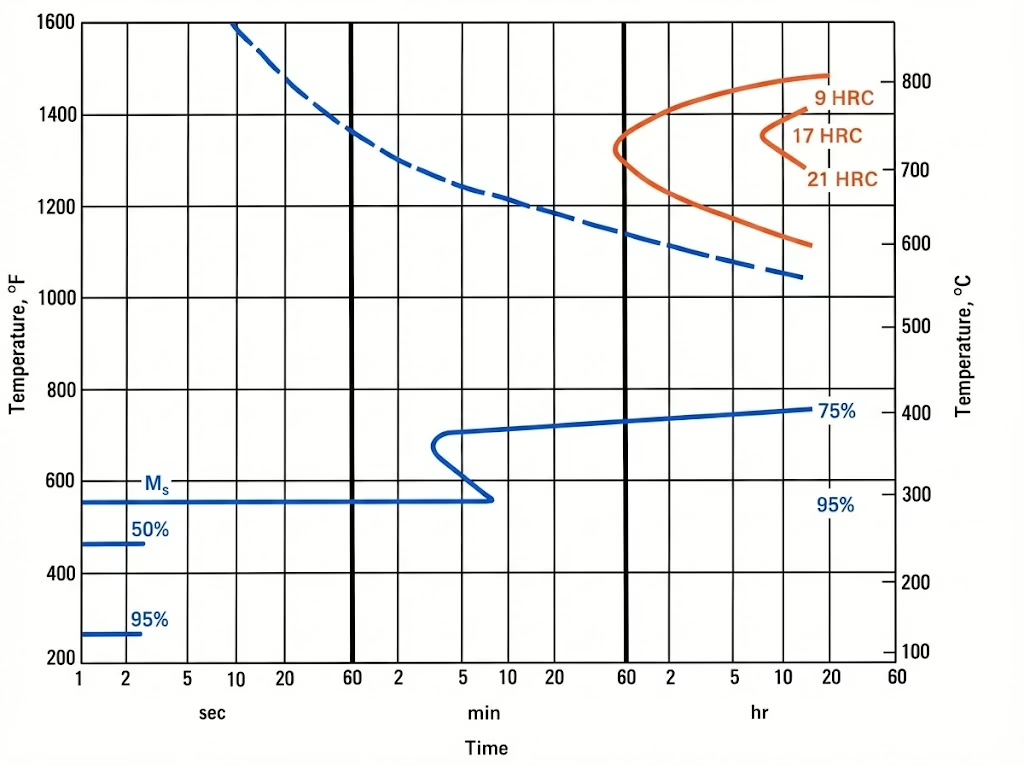
Quenching is the process of transforming austenite into a hard martensitic structure through controlled rapid cooling. H10 exhibits deep quenching penetration, enabling complete hardening at relatively slow cooling rates compared with ordinary carbon steels.
Standard quenching media include air, inert gas, or graded oil/salt baths; water quenching is strictly prohibited to prevent cracking.
In terms of process selection, gas(air) quenching is suitable for various cross-sections and minimizes deformation. Graded oil/salt quenching, however, effectively reduces scale formation and ensures uniform hardening of large-section workpieces by maintaining temperature equilibrium in a 595–650°C (1105–1200°F) medium before air cooling H10 components.
Quenching should be terminated promptly when the H10 tool cools to approximately 50°C to 66°C (120°F to 150°F), and the tempering process should be initiated immediately to prevent stress cracking in the workpiece.
Tempering
The quenched martensitic structure exhibits extreme brittleness and high internal stresses. Tempering is essential to enhance the material’s toughness, plasticity, and dimensional stability.
For H10 tool steel, dual tempering is strongly recommended: the second tempering allows the martensite formed during the first tempering’s cooling to be fully tempered, thereby effectively reducing the risk of brittle fracture during the workpiece’s subsequent service life.
In terms of process, tempering should be performed immediately after quenching, employing a slow heating method. The holding time for each tempering cycle must be calculated to be at least 2 hours per inch of the workpiece’s cross-sectional thickness to ensure complete microstructural transformation.
H10 Tempering Temperature and Hardness Comparison Chart
| Tempering Temperature | Approximate Hardness (HRC) |
|---|---|
| As Quenched | 56–59 |
| 400°C (750°F) | 52–54 |
| 500°C (930°F) | 54–55 |
| 550°C (1020°F) | 54–55 |
| 600°C (1110°F) | 49–51 |
| 650°C (1200°F) | 41–43 |
H10 Heat Treatment Troubleshooting
Note: Although H10 and H11 belong to different grades, as representative chromium-based hot-work tool steels (Cr-Mo-V series), they share similar issues during heat treatment. Therefore, the following guidelines also apply to common fault diagnosis and repair for H11 tool steel.
Quenching Cracking
Cracks appear during or immediately after quenching. The cause may be that the workpiece was not tempered immediately after quenching, thereby preventing the immense structural stresses generated during quenching from being promptly released. It is essential to promptly transfer the workpiece to a preheated tempering furnace for tempering once its temperature has dropped to approximately 50-60°C.
Surface Soft Spots
Surface soft spots primarily manifest as an uneven hardness distribution across the workpiece surface, with localized low-hardness areas. This phenomenon arises primarily from two causes: First, during liquid quenching, locally formed vapor films can impede direct contact between the cooling medium and the workpiece, resulting in insufficient cooling rates and consequently uneven hardening. Second, inadequate protection during heating may cause surface decarburization, leading to carbon loss and preventing the surface layer from reaching the intended hardness.
To address these causes, the following corrective measures are implemented: During quenching, thoroughly agitate the quenching medium to break the vapor film; during the austenitizing stage, employ controlled-atmosphere methods such as vacuum furnaces, salt baths, or protective foils to prevent decarburization.
Insufficient Hardness
Insufficient hardness primarily manifests as steel failing to achieve the intended hardness after heat treatment. This typically stems from one of three causes: the austenitizing temperature was too low, the holding time was insufficient, or the cooling rate during quenching was too slow.
The solution involves regularly calibrating the furnace temperature and inspecting the thermocouple positioning to ensure the measured workpiece temperature falls within the specified hardening range of 1010°C to 1040°C, as required by H10, while ensuring sufficient soaking time to promote microstructural transformation. During the air-quenching stage, increase cooling intensity by raising the cooling-air pressure or circulation velocity to achieve the desired martensitic microstructure.
Insufficient impact toughness
Insufficient impact toughness primarily manifests as unexpected brittle fracture occurring during the early service life of components. Potential causes include: excessively slow quenching cooling rates, leading to preferential precipitation of alloy carbides along grain boundaries and thereby weakening intergranular bonding; or, if the tempering temperature falls precisely within the temper brittleness sensitivity zone of 500°C to 550°C, significant embrittlement may also be induced.
Solutions include: increasing the cooling rate during quenching to effectively suppress carbide precipitation at grain boundaries; avoiding the embrittlement temperature range during tempering, and opting for “over-aging” tempering at temperatures exceeding the secondary hardening peak. This approach achieves optimal toughness while maintaining necessary hardness.
FAQ
The austenitizing temperature ranges from 1010°C to 1040°C (1850°F to 1900°F). Once the workpiece reaches this temperature, hold it for 15 to 40 minutes to prevent excessive grain growth.
No, water quenching is strictly prohibited because it can cause cracking. Recommended quenching media include air, inert gas, or graded oil/salt baths.
Uniformly heat the workpiece to 650–675°C (1200–1250°F) for at least one hour per inch of thickness. After holding, allow the workpiece to cool slowly in the air.
Dual tempering is strongly recommended. A second tempering cycle ensures that martensite formed during the first cycle’s cooling is fully tempered, reducing the risk of brittle fracture.
Cracking often occurs when the workpiece is not tempered immediately after quenching. You must transfer the steel to a tempering furnace once it cools to approximately 50–60°C to release stresses.
Soft spots are caused by vapor films that block cooling during liquid quenching or by surface decarburization due to poor protection during heating. Agitating the quench medium and using controlled atmospheres prevent these issues.
The holding time for each tempering cycle should be calculated based on a minimum of 2 hours per inch of the workpiece’s cross-sectional thickness.
Tempering H10 tool steel at 500°C (930°F) typically yields a hardness of 54–55 HRC.