

Home > Tool Steel Heat Treatment Technical Center > D3 Tool Steel Heat Treatment Guide
Aobo Steel | Global Tool Steel Supplier in China
D3 Tool Steel Heat Treatment Guide
Heat treatment guidance for D3 tool steel (DIN 1.2080 | JIS SKD11), focusing on very high hardness, wear resistance, and dimensional stability for cold-work tooling applications.
This guide, compiled from professional resources and years of industry experience, covers the quenching and tempering procedures for machined components made from D3 tool steel. D3 is characterized by high wear resistance and deep hardening capability. Unlike air-cooled D2 steel, D3 steel requires oil quenching, a process that requires deformation and cracking to be avoided.
A Quick Checklist for D3 Tool Steel Heat Treatment
Time needed: 1 day
This guide outlines the quenching and tempering procedures for machined components made from D3 tool steel.
- Preheating
Heat the component extremely slowly from room temperature to 815°C (1500°F) and hold at this temperature until the component is uniformly heated to avoid thermal shock and cracking.
- Austenitizing (Hardening)
Heat the furnace to between 925°C and 980°C (1700°F to 1795°F) and soak small workpieces for 15 minutes or large workpieces for up to 45 minutes. To prevent decarburization, use a vacuum furnace or tightly wrap the steel in stainless steel foil or clean cast iron chips.
- Quenching
Rapidly transfer the component to a warm oil bath and quench until the workpiece reaches 50°C to 66°C (120°F to 150°F), then remove the tool while it is still warm to the touch. Agitate the oil bath or move the component during this process to disrupt vapor films and prevent soft spots.
- Tempering (First Cycle)
Immediately place the hand-warm component into a preheated tempering furnace to prevent cracking, heating it to between 150°C and 540°C (300°F and 1000°F) depending on desired hardness. Hold the temperature for 1 hour per inch (25 mm) of thickness, with a generally recommended minimum of 2 hours.
- Cooling
Allow D3 tool steel to cool to room temperature to eliminate martensitic stresses formed during the first tempering stage.
- Tempering (Second Cycle)
Reheat the tool to the same temperature used in the first cycle and hold for 1 hour per inch (25 mm) of thickness (minimum 2 hours) to transform retained austenite.
Preheating
D3 steel has low thermal conductivity and absorbs heat slowly. Placing room-temperature D3 tool steel directly into a high-temperature furnace can easily cause thermal shock and result in cracking. Therefore, heating must begin extremely slowly from room temperature. Preheat the component to 815°C (1500°F) and hold it at this temperature until it is uniformly heated. Only then should the furnace temperature be raised to the austenitizing temperature.
Austenitizing (Hardening)
Following the previous step, heat the furnace to 925°C to 980°C (1700°F to 1795°F). Small D3 workpieces require a 15-minute soak, while large workpieces may soak for up to 45 minutes. Atmosphere control during heating is essential to prevent decarburization. Vacuum furnaces are preferred as they prevent decarburization and preserve the bright surface of D3 tool steel. If such equipment is unavailable, D3 tool steel should be tightly wrapped in stainless steel foil or packed in clean, dry, inert materials, such as cast iron chips.
Quenching
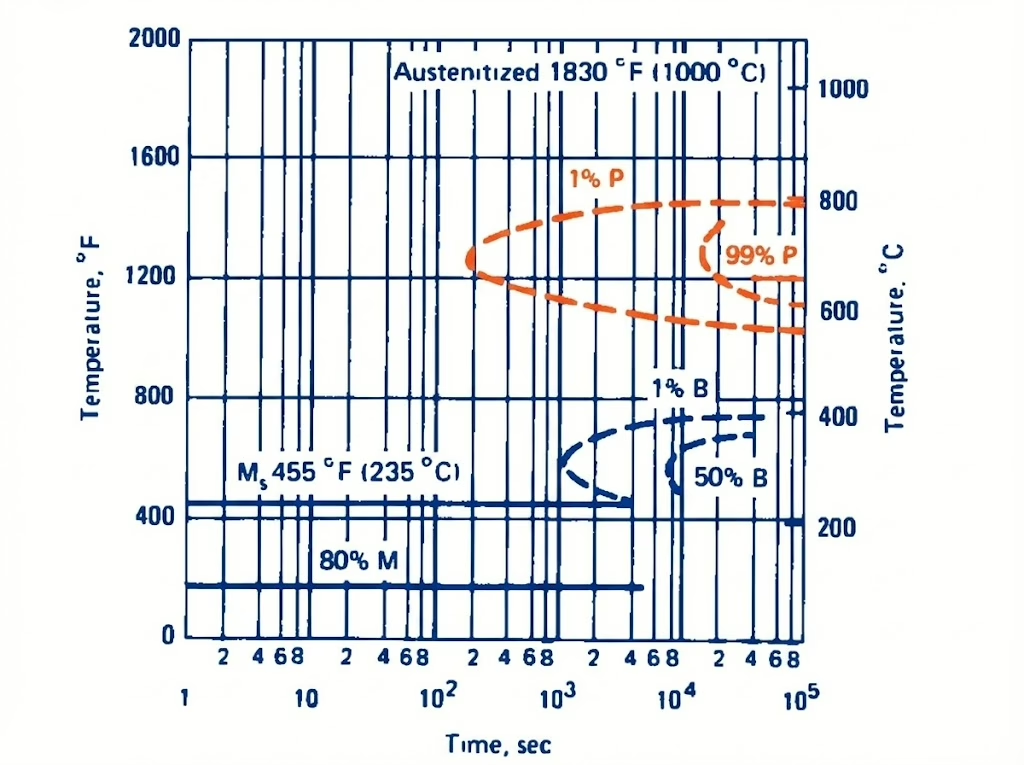
Unlike D2 steel, which can be quenched in air, D3 steel must be quenched in warm oil to transform austenite into martensite and achieve maximum hardness. During operation, components must be rapidly transferred from the furnace to the oil bath and quenched until the workpiece temperature reaches approximately 50°C to 66°C (120°F to 150°F), meaning removal should occur while the tool remains warm to the touch. Never allow the tool to reach room temperature before tempering, as this significantly increases the risk of cracking. The expected hardness after this process is approximately 64 to 66 HRC.
Tempering
Since quenched martensite is extremely brittle and under high internal stress, failure to temper immediately may cause cracking. Therefore, tempering must be performed immediately after quenching. The standard practice for D-series steels is to employ a two-step tempering process to transform retained austenite and eliminate martensitic stresses formed during the first tempering cooling. The specific process is as follows: Heat D3 to the tempering temperature. The holding time is calculated as 1 hour per inch (25 mm) of tool steel thickness. For stability, a minimum of 2 hours is generally recommended. After the tool cools to room temperature, reheat it to the same temperature for the second tempering.
| Tempering Temperature | Rockwell C (HRC) |
| As quenched | 66 |
| 300°F / 150°C | 65 |
| 400°F / 205°C | 61 |
| 500°F / 260°C | 58 |
| 600°F / 315°C | 57 |
| 700°F / 370°C | 57 |
| 800°F / 425°C | 56 |
| 900°F / 480°C | 55 |
| 1000°F / 540°C | 52 |
Deep Cryogenic Treatment (Optional)
To maximize dimensional stability and hardness, deep cryogenic treatment can be applied to convert retained austenite into martensite. The process requires continuous cooling from quenching to -75°C to -196°C, followed by immediate tempering upon return to room temperature to relieve internal stresses.
Common Issues and Solutions in D3 Heat Treatment
Quench Cracking
Quench cracking refers to fractures occurring during or immediately after the quenching stage. Since D3 steel requires more aggressive oil quenching than air cooling, cracking typically occurs if components are cooled excessively in the quenching medium (below 50°C) or if there is a delay between quenching and tempering. Additionally, high internal stresses resulting from uneven hardening—where the surface hardens but the interior remains unhardened—also contribute to this phenomenon.
The solution is to ensure proper preheating to minimize thermal shock and to remove components from the oil when they reach hand-warm temperatures (50°C–66°C), then immediately place them in a preheated tempering furnace.
Low Hardness
Insufficient hardness occurs when a D3 tool steel fails to reach the expected HRC. There are typically two causes: first, improper control of the heat-treatment atmosphere, leading to surface decarburization; second, excessively high austenitizing temperatures, which stabilize austenite, prevent its transformation into martensite, and result in retained austenite.
Soft Spots
Soft spots are localized areas of reduced hardness on the surface of D3 tool steel. This occurs because during oil quenching, a vapor film with low thermal conductivity may form around the D3 steel. This film slows the cooling rate of the covered areas, thereby inhibiting the formation of martensite in these regions.
The solution is to disrupt the vapor film during the D3 quenching process by agitating the oil bath or moving the D3, thereby ensuring uniform heat transfer.
Dimensional Distortion
Dimensional distortion refers to dimensional changes or warping that occur in D3 during heat treatment. This is because D3 is a deep-hardening steel, and the phase transformation from austenite to martensite causes volumetric expansion; thermal stresses generated by uneven heating or cooling exacerbate the distortion.
There are two approaches to resolving this issue. First, maintain cross-sectional symmetry as much as possible during the design of tools and dies. Second, perform stress relief treatment after D3 rough machining and before quenching. Use graded preheating to ensure uniform temperature distribution before reaching high temperatures, and employ vertical quenching to minimize warping. Additionally, allow machining allowance for post-quenching grinding.
Stable D3 Heat Treatment Starts with Quality Tool Steel
Get consistent heat-treatment results and maximum wear resistance. Aobo Steel provides forged D3 (1.2080) with UT D/d grade integrity and < 255 HB annealed hardness. Backed by 20+ years of expertise, we offer factory-direct pricing for reliable, high-performance cold-work steel.
FAQ
You must heat D3 extremely slowly from room temperature to avoid thermal shock. Preheat the component to 815°C (1500°F) and hold there until it is uniformly heated before increasing to the hardening temperature.
Heat the furnace to between 925°C and 980°C (1700°F to 1795°F). Small workpieces require a 15-minute soak, while larger pieces may need up to 45 minutes.
Unlike D2, D3 must be quenched in warm oil to achieve maximum hardness. Rapidly transfer the component to the oil bath until it reaches 50°C–66°C (120°F–150°F), removing it while it is still warm to the touch.
Use a two-step tempering process immediately after quenching to prevent cracking. Heat for at least 2 hours (or 1 hour per inch of thickness), cool to room temperature, and then reheat to the same temperature.
Soft spots occur when a vapor film forms during oil quenching, slowing the cooling rate in specific areas. Prevent this by agitating the oil bath or moving the component to disrupt the film and ensure uniform heat transfer.
Ensure proper preheating to minimize thermal shock and avoid cooling the component below 50°C in the quenching medium. Remove the steel when it is hand-warm and place it immediately into a preheated tempering furnace.
The expected hardness after quenching is approximately 64 to 66 HRC. After tempering, hardness ranges from 65 HRC at 150°C (300°F) down to 52 HRC at 540°C (1000°F).
Perform stress relief treatment after rough machining and use graded preheating to ensure uniform temperature distribution. Additionally, use vertical quenching and maintain cross-sectional symmetry in the tool design to minimize warping.