
Home > Tool Steel Catalog > A2 Tool Steel
Aobo Steel | Global Tool Steel Supplier in China
AISI A2 Tool Steel | 1.2363 | SKD12 Cold Work Tool Steel for Bulk Supply
✓100% UT Tested Quality Assurance
✓SEP 1921-82 Class D/d Guaranteed
✓Annealed State Delivery
✓Surface: Black Scale, Turned, Mill Finish, or Polished
A2 tool steel (DIN 1.2363 / SKD12) is a stable air-hardening cold work tool steel designed for applications requiring controlled distortion, reliable wear resistance, and good toughness. It is widely used in blanking dies, forming tools, punches, and thread rolling dies. Equivalent Grades: DIN 1.2363 (X100CrMoV5), JIS SKD12, GB/T Cr5Mo1V.
Supply Overview
| Item | Specification |
|---|---|
| Grade | AISI A2 / DIN 1.2363 / JIS SKD12 |
| Delivery Condition | Fully Annealed (≤ 255 HB) |
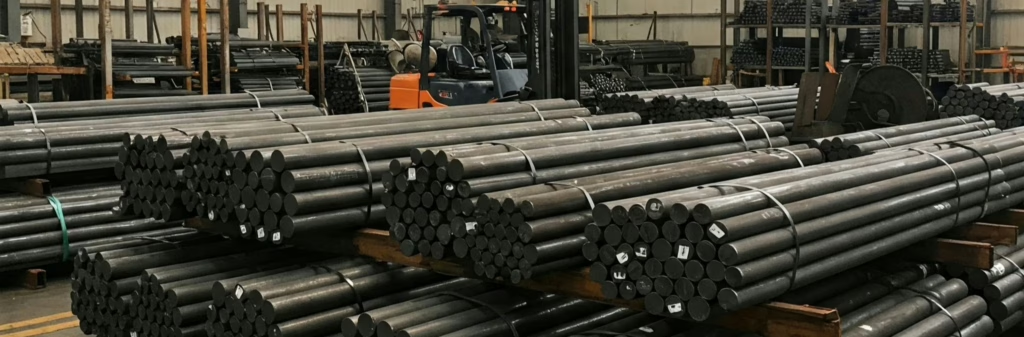
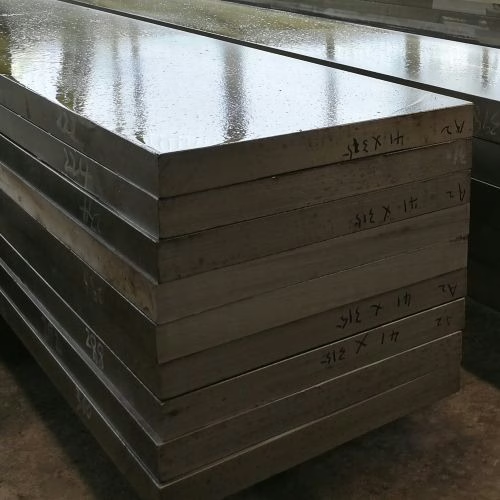
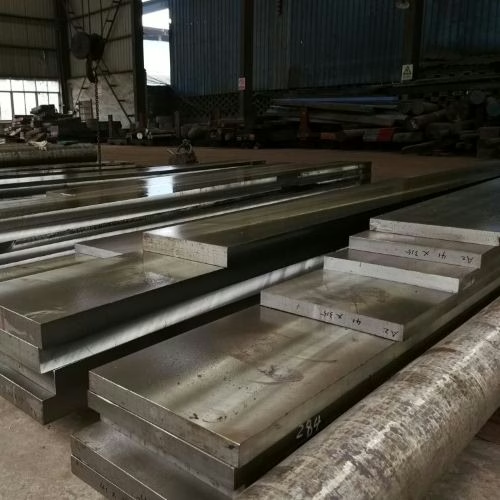
| Available Forms | Round Bar / Plate / Forged Block |
| Length | 2–5.5m (Container Optimized) |
| Surface Condition | Black / Turned (0/+1mm) / Milled Plate (0/+1mm) |
| Monthly Supply Capacity | Approx. 1000–1200 metric tons |
| Recommended Export Quantity | Full 20GP container (~26 tons) |
| MOQ | 5 tons |
| Lead Time (Ingot Stock) | Approx. 20 days |
| Lead Time (Fresh Melt) | 30–45 days |
| Lead Time (ESR Grade) | Approx. 60 days |
| UT Standard | Sep 1921-82 Class D/d or E/e |
| Inspection | In-house UT + Third-party available |
| Documentation | MTC (EN 10204 3.1) + UT Report |
Production Stability
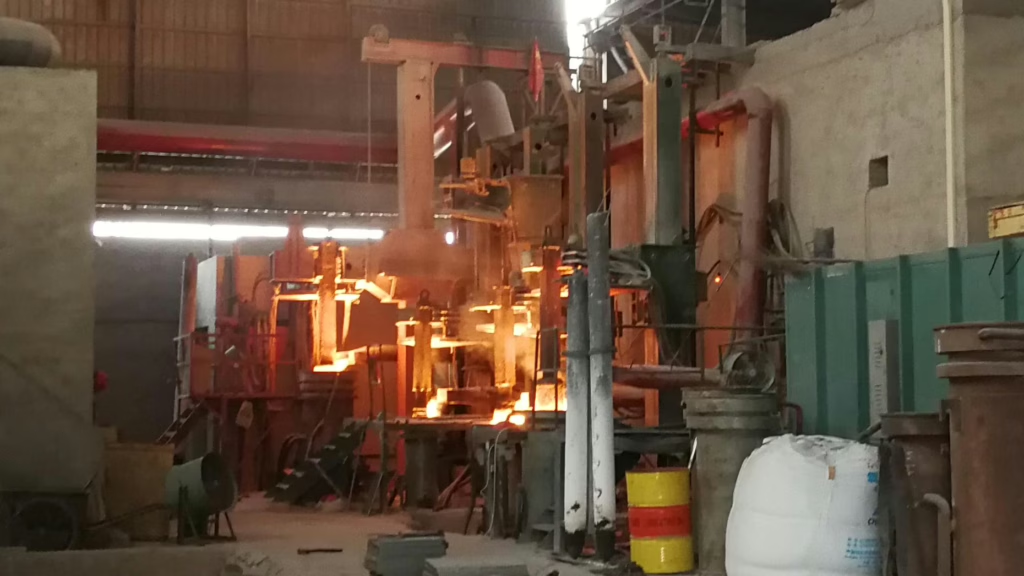
- Stable monthly supply around 1000–1200 tons
- Continuous production cycle for distributor inventory replenishment
- ESR grade available upon request
- Controlled alloy sourcing to maintain hardness consistency
- Full heat number traceability with MTC per batch
Packaging and Shipping
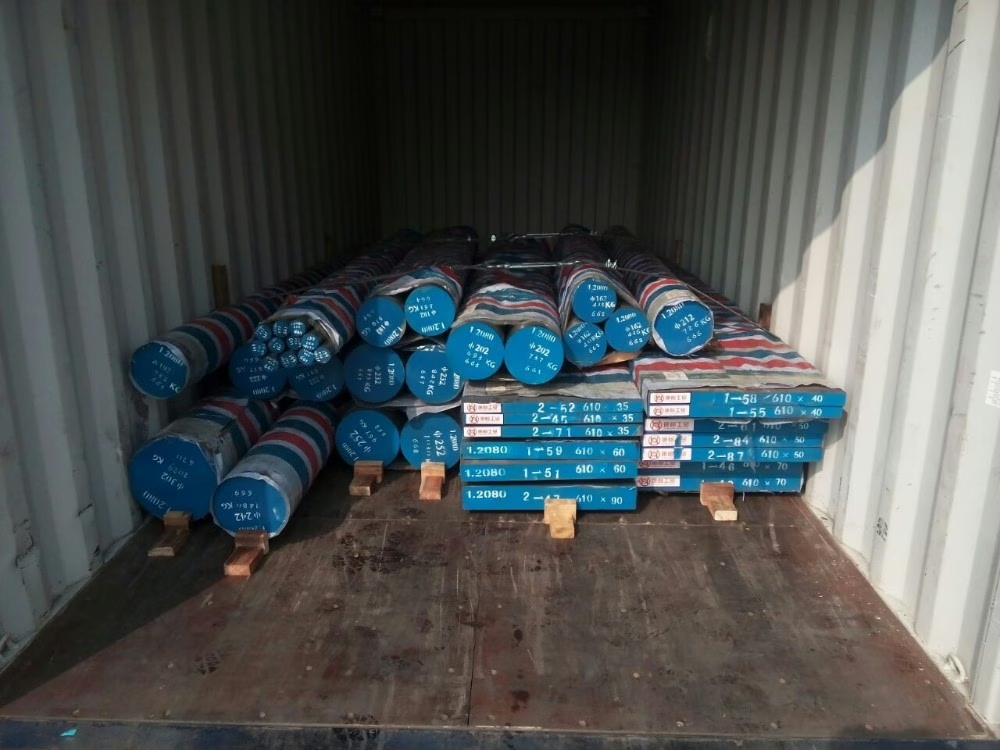
- Professional seaworthy export packing
- 20GP loading optimized up to ~26 tons
- Mixed sizes supported within one container
- Anti-rust oil protection for sea transit
- Length 2–5.5m optimized for container efficiency
For international shipment, full container loading is strongly recommended to ensure cost efficiency and smoother customs processing.
AISI A2 Tool Steel | DIIN 1.2363 | JIS SKD12 Gallery
Applications
A2 tool steel is widely used for tooling operations performed at temperatures below 200°C (typically room temperature). It is an economical choice for general shop purposes. Its applications span situations demanding extreme hardness, friction resistance, durability, and strength, and it’s suitable where improved toughness and reasonable abrasion resistance are needed.
- Bending dies
- Blanking dies and punches (for long runs or thin/medium-thickness stock)
- Coining dies
- Cold forming tools
- Drawing dies
- Extrusion dies and punches for aluminum
- Forming dies
- Gages and precision measuring tools (due to dimensional stability)
- Knurls
- Mandrels
- Master hubs
- Molds
- Planer tools
- Shear knives and blades (cold shears for light and medium duty, trimming dies)
- Slitter knives
- Spindles
- Punches (even over wear-resistant D2)
A2 Steel Composition
| Element | Carbon (C) | Chromium (Cr) | Molybdenum (Mo) | Vanadium (V) | Manganese (Mn) | Silicon (Si) | Phosphorus (P) | Sulfur (S) |
| Percentage (%) | 0.95 – 1.05 | 4.75 – 5.50 | 0.90 – 1.40 | 0.15 – 0.50 | 0.40 – 1.00 | 0.30 – 0.90 | ≤ 0.03 | ≤ 0.03 |
A2 Steel Properties
Basic Physical Properties and Mechanical Properties
| Property | Value |
|---|---|
| Density | 7.86 g/cm³ |
| Melting Point | 1424°C |
| Bulk modulus | 140 GPa |
| Shear modulus | 78.0 GPa |
| Poisson’s ratio | 0.27-0.30 |
| Elastic modulus | 190-210 GPa |
| Thermal expansion | 10.7 x 10⁻⁶/°C |
Hardness
The hardness after annealing is 235 HB to 269 BHN. In the as-quenched condition, A2 can achieve a surface hardness of 60 HRC. As-quenched hardness is influenced by austenitizing temperature. The hardness after tempering is 58–64 HRC. Tempering at 200°C (390°F) can achieve a hardness of 60 HRC.
Wear Resistance
The high carbon and chromium content give A2 excellent wear resistance. Compared to O1 steel, A2 steel has slightly better wear resistance. Compared to A6 steel, its wear resistance is improved by 20-25%. However, its wear resistance is lower than that of D2 steel or high-speed steel.
Toughness
A2 steel has moderate toughness, higher than oil-hardening die steels and D-series tool steel. Toughness and wear resistance are inversely proportional. The high carbide content in D-series tool steel increases wear resistance but reduces toughness.
Dimensional Stability
A2 steel undergoes minimal deformation during hardening. The expansion is approximately 0.001 inches/inch (0.001 mm/mm).
Machinability
A2 steel is easy to machine after appropriate annealing. If the machinability of tool steel with 1% carbon is set to 100, then the machinability rating of A2 is 65.
Heat Treatment
A2 is an air-hardening cold work tool steel with good dimensional stability during quenching.
Typical hardening parameters:
- Austenitizing: 1775–1825°F (970–995°C)
- Quenching: Air
- Recommended: Double tempering
Typical working hardness: 58–62 HRC
Final hardness depends on section size and tempering temperature.