
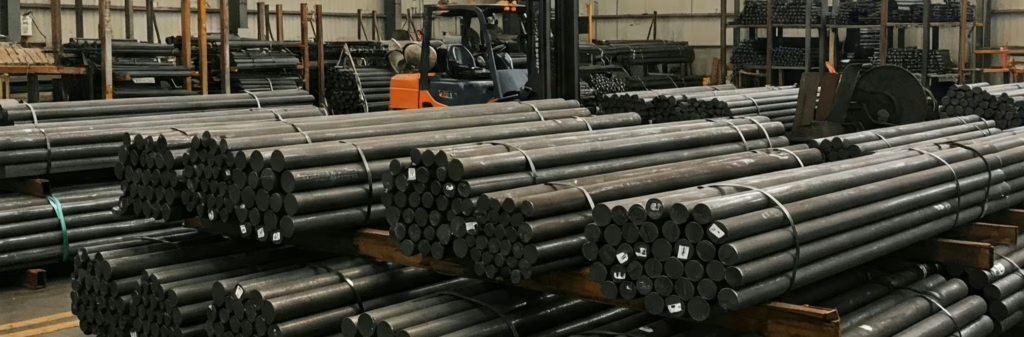
4Cr13 stainless steel, frequently designated as 40Cr13 or SM4Cr13 in Chinese standards, is categorized as a martensitic stainless steel. The “4” in its nomenclature typically signifies a carbon content of approximately 0.4%.
4Cr13 steel is a martensitic stainless steel with good machinability. It possesses high strength and wear resistance, as well as excellent corrosion resistance, capable of withstanding steam, weak organic acids, dilute sulfuric acid, and carbonates. Its good polishing performance makes it suitable for manufacturing transparent and opaque plastic product molds that are subjected to high loads, high wear, and corrosive media. Applications include molds for optical lenses (corrosive), resin material products, and resin products with additives. This steel is recommended for all plastic mold manufacturing. Due to its special properties, it is particularly suitable for demanding environments, such as corrosion-resistant and rust-proof molds (e.g., molds for injection materials containing corrosive acetate salts), molds with low surface roughness requirements, complex molds with good toughness and ductility, and large plastic molds requiring high transparency.
1. Composition(YB / T 094—1997)
| C | Si | Mn | Cr | S | P |
| 0.36 ~ 0.45 | ≤0.60 | ≤0.80 | 12.00 ~ 14.00 | ≤0.030 | ≤0.030 |
2. Physical Properties of 4Cr13 Stainless Steel
2.1 Critical Temperature
| Critical Point | Ac1 | Ac3 | Ms |
| Temperature (°C) | 820 | 1100 | 270 |
2.2 Coefficient of Linear Expansion
| Temperature (°C) | 20 ~ 100 | 20 ~ 200 | 20 ~ 300 | 20 ~ 400 | 20 ~ 500 |
| α (x 10⁻⁶/°C) | 10.5 | 11.0 | 11.0 | 11.5 | 12.0 |
2.3 Thermal Conductivity
| Temperature (°C) | 20 | 200 | 400 | 600 |
| λ [W/(m·K)] | 27.6 | 28.8 | 28.8 | 28.4 |
2.4 Modulus of Elasticity
| Temperature (°C) | 20 | 400 | 500 | 600 |
| E (MPa) | 210000 ~ 223500 | 197000 | 185000 | 174000 |
2.5 Electrical Resistivity
| Temperature (°C) | 20 | 100 |
| ρ (x 10⁻⁶ Ω·m) | 0.55 | 0.65 |
2.6 Other Physical Properties
| Density (g/cm³) | Specific Heat Capacity cₚ (20°C) / [J/(kg·K)] |
|---|---|
| 7.7 | 459.8 |
3. Forging process 4Cr13 Stainless Steel
| Heating | Initial Forging Temperature (°C) | Final Forging Temperature (°C) | Cooling |
| Heat slowly to 800°C, then rapidly to 1200°C | 1160 ~ 1200 | ≥850 | Cool in ash or sand |
Note: Tempering should be carried out promptly after forging.
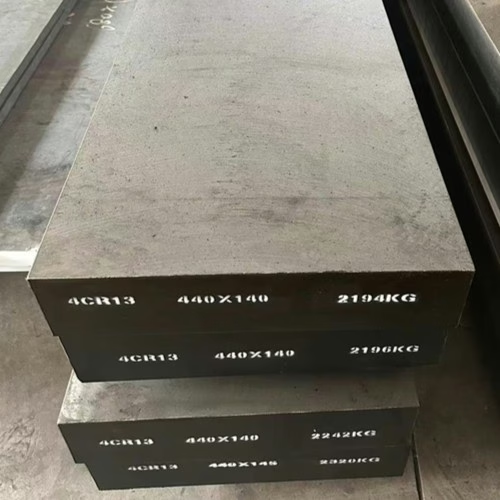
Please fill out the following form to contact us for the most competitive quotation of 4Cr13 stainless steel.
4. Heat Treatment 4Cr13 Stainless Steel
4.1 Preheating
| Preliminary Heat Treatment Plan | Heating Temperature/°C | Cooling Method | Hardness HBW |
| Post-forging Annealing | 750 ~ 800 | Furnace cool to 500°C, then air cool | ≤217 |
| Stress Relief Annealing | Soak at 650°C for 2h | Slowly cool to 500°C, then air cool | — |
4.2 Quenching
| Quenching Temperature/°C | Cooling Method | Hardness HRC |
| 1000 ~ 1050 | Oil Cooling | 52 ~ 55 |
4.3 Tempering
| Tempering Temperature/°C | Cooling Method | Hardness HRC |
| 200 ~ 300 | Air Cooling | 50 ~ 53 |
Relationship between Tempering Temperature and Hardness
| Tempering Temperature/°C | After Quenching | 200 | 300 | 400 | 500 | 550 | 600 | 650 |
| Hardness HRC | 54 | 53 | 52 | 51 | 50 | 44 | 33 | 28 |
5. Mechanical Properties 4Cr13 Stainless Steel
5.1 Mechanical Properties of 4Cr13 Steel at Different Temperatures
| Mechanical Property | Room Temperature | 200°C | 300°C | 400°C | 500°C | 600°C |
| Tensile Strength (Rm)/MPa | 1125 | 960 | 915 | 790 | 525 | 310 |
| Yield Strength (ReL)/MPa | 905 | 820 | 720 | 680 | 470 | 260 |
| Elongation (A)/% | 11 | 10.5 | 10 | 11.5 | 19 | 20 |
| Reduction of Area (Z)/% | 32 | 40 | 39 | 45 | 75 | 82 |
| Impact Toughness (ak)/(J/cm²) | 10 | 50 | 70 | 71 | 80 | 105 |
Note: 1050°C air cooling, 650°C x 3h tempering.
5.2 Room Temperature Mechanical Properties
| Heat Treatment | Tensile Strength (Rm)/MPa | Yield Strength (ReL)/MPa | Elongation (A)/% | Reduction of Area (Z)/% | Hardness HRC | Hardness after Annealing HBW |
| 1050 ~ 1100°C oil quenching, 200 ~ 300°C tempering | 1140 | 910 | 12.5 | 32 | ≥50 | ≤229 |
| 1050°C air cooling, 600°C, 3h tempering, 860°C annealing | 480 ~ 560 | 20 ~ 25 | 50 ~ 67 | 143 ~ 229 |
5.3 High-Temperature Tensile Properties
| Heat Treatment | Test Temperature/°C | Tensile Strength (Rm)/MPa | Yield Strength (ReL)/MPa | Elongation (A)/% |
| 1030°C air cooling,<br>500°C tempering air cooling | 20 | 1800 ~ 1820 | 1630 ~ 1650 | 2.5 |
| 400 | 1660 ~ 1700 | 1450 ~ 1480 | 6 | |
| 450 | 1570 ~ 1600 | 1350 ~ 1420 | 5 ~ 6 | |
| 500 | 1310 ~ 1340 | 1250 ~ 1290 | 6.5 | |
| 1030°C air cooling,<br>600°C tempering air cooling | 20 | 1130 ~ 1160 | 970 | 9.2 ~ 10 |
| 400 | 920 ~ 960 | 790 ~ 830 | 8.3 ~ 10 | |
| 450 | 800 ~ 820 | 620 ~ 650 | 10 ~ 12 | |
| 500 | 710 ~ 730 | 580 ~ 600 | 14.5 ~ 15 |
6. Applications
- Molds: It is widely used for plastic molds, especially for producing transparent and opaque plastic products, and molds that operate in corrosive environments (e.g., those processing plastics with corrosive additives like acetates). Its superior polishing characteristics make it ideal for molds requiring very smooth surfaces.
- Medical Instruments: Components for surgical medical instruments.
- Cutlery: Blades for various types of knives.
- Machine Components: Employed for high-stress, wear-prone parts such as bearings, valves, valve plates, shafts, bolts, and springs.
- Measuring Tools: Given its high hardenability and minimal distortion after heat treatment, it is also a choice for frequently used measuring tools or reference gauges.
7. Equivalent Grades
• International (ISO/TS 15510, EN 10088-1): X39Cr13 (1.4031) or X46Cr13 (1.4034).
• Russian (GOST): 40X13.
• Japanese (JIS): SUS420J2.
• USA (AISI/SAE/UNS): While not a direct equivalent due to carbon content variations, AISI 420 (S42000) is often referenced. AISI 420 stainless steel generally has a lower carbon content compared to 4Cr13.
FAQ
Yes, 4Cr13 can be a good knife steel, particularly for general-purpose applications. It is a martensitic stainless steel that can be heat-treated to achieve a good level of hardness, which contributes to edge retention.
4Cr13 is a martensitic stainless steel commonly used in the manufacture of tableware. D2, on the other hand, is a high-carbon, high-chromium cold-work tool steel used for molds and punches. D2 contains a large amount of hard carbides, resulting in higher hardness and wear resistance than 4Cr13, but lower toughness.
4Cr13 steel is a type of stainless steel. However, like many martensitic stainless steels, its corrosion resistance is affected by carbon content and heat treatment, as carbon forms carbides with chromium, which may cause corrosion under certain conditions or if maintenance is inadequate.
The carbon content of 4Cr13 is higher than that of 3Cr13, so after heat treatment, the hardness of 4Cr13 is higher than that of 3Cr13. However, the higher carbon content in 4Cr13 may make its corrosion resistance slightly inferior to that of 3Cr13, as more chromium elements may be bound by carbides.
Get a Competitive Quote for 4Cr13 Stainless Steel
With over 20 years of forging expertise, Aobo Steel is your trusted partner for high-performance 4Cr13 stainless steel. We provide not just materials, but solutions. Leverage our deep industry knowledge and reliable supply chain for your project’s success.
✉ Contact us by filling out the form below.