
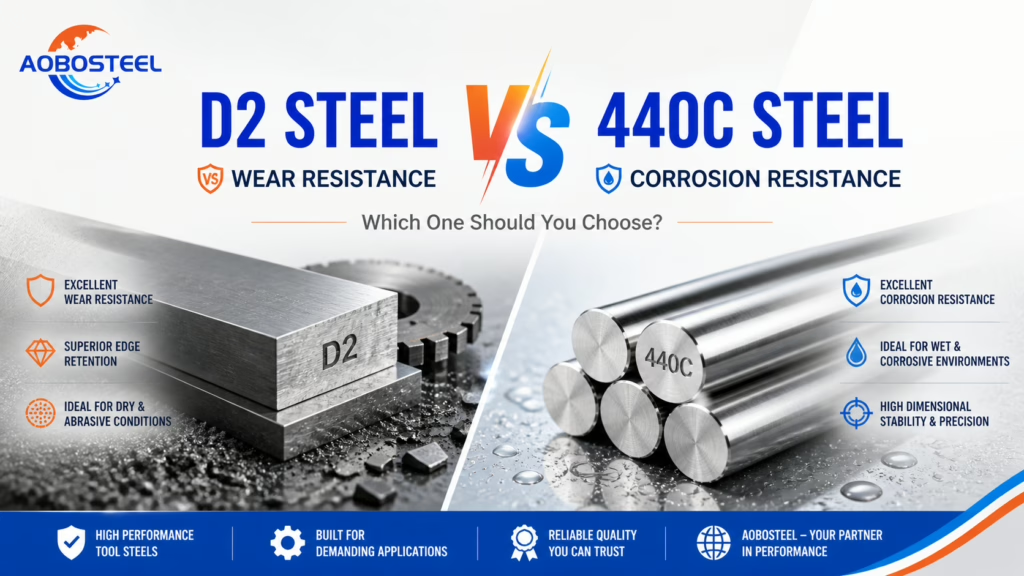
D2 Steel vs 440C Steel: Which One Should You Choose?
D2 is selected for dry abrasive wear, while 440C is selected when high hardness must be combined with corrosion resistance. The practical difference is that D2 solves wear problems. 440C solves hardness plus corrosion-resistance problems.
D2 vs 440C: Quick Selection Guide
| If your requirement is… | Choose | Why |
| Dry industrial environment with heavy abrasive wear | D2 | High carbide volume gives superior wear resistance and edge retention |
| Long production runs and tooling life | D2 | Reduces resharpening frequency and improves tool life economics |
| Precision tooling with low distortion requirement | D2 | Air hardening provides excellent dimensional stability |
| Severe cold forming or high compressive stress | D2 | Performs well at high hardness in cold-work applications |
| Humid, wet, or mildly corrosive environment | 440C | High chromium enables true corrosion resistance |
| High hardness combined with corrosion resistance | 440C | Maintains hardness while resisting rust and pitting |
| Precision mechanical parts such as bearings, valves, and pump components | 440C | Suitable for contact components requiring both hardness and corrosion resistance |
| Clean or corrosion-sensitive service conditions | 440C | Better resistance to staining, oxidation, and chemical attack |
D2 vs 440C Steel Chemical Composition
| Element | D2 Tool Steel | 440C Stainless Steel | Meaning |
| Carbon | 1.40–1.60% | 0.95–1.20% | D2 forms more carbides, giving it stronger wear resistance |
| Chromium | 11.00–13.00% | 16.00–18.00% | 440C has stronger stainless behavior and corrosion resistance |
| Molybdenum | 0.70–1.20% | ≤0.75% | Supports hardenability and performance stability |
| Vanadium | 0.50–1.10% | Not a major standard addition | Improves D2 wear resistance and grain refinement |
| Manganese / Silicon | ≤0.60% | ≤1.00% | Secondary elements supporting processing and hardenability |
D2’s higher carbon and carbide volume explain its stronger abrasive wear resistance. 440C’s higher chromium content explains why it performs better in humid, wet, or mildly corrosive environments.
D2 vs 440C: Equivalent Grades and International Standards
When sourcing materials globally, D2 and 440C may appear under different international standards. These designations help buyers match materials across markets, but they should not be treated as automatic substitutes without checking the exact specification.
| Standard System | D2 Tool Steel | 440C Stainless Steel |
| UNS | T30402 | S44004 |
| DIN / EN | 1.2379 / X153CrMoV12 | 1.4125 / X105CrMo17 |
| JIS | SKD11 | — |
| GB | Cr12Mo1V1 | — |
| ISO | 160CrMoV12 | — |
| BS | BD2 | — |
| AFNOR | X155CrMoV12 | — |
| SAE | — | 51440C |
| ASTM | — | A276 / A580 Type 440C |
| AMS | — | AMS 5618 / AMS 5630 |
| Federal Specification | — | QQ-S-763 440C |
| Commercial Grades | Böhler K110, ASSAB XW41, Hitachi SLD, Daido DC11 | — |
D2 vs 440C Steel Property Comparison
| Feature | D2 Tool Steel | 440C Stainless Steel |
| Steel type | High-carbon, high-chromium cold-work tool steel | High-carbon martensitic stainless steel |
| Hardness potential | Up to about 62–64 HRC, depending on heat treatment | Up to about 60–64 HRC, depending on heat treatment |
| Practical working hardness | Commonly around 58–60 HRC depending on application | Commonly around 57–60 HRC depending on corrosion and toughness requirements |
| Wear resistance | Extremely high; stronger in dry abrasive tooling | Good, but generally below D2 under heavy dry abrasion |
| Toughness | Low to moderate after hardening; chipping risk under impact | Low to moderate after hardening; not suitable for heavy impact |
| Corrosion resistance | Limited; not a true stainless steel | Good for a martensitic stainless steel |
| Best environment | Dry industrial service where abrasive wear is the main risk | Humid, wet, or mildly corrosive service where rust prevention matters |
Corrosion resistance is often the dividing line between these two grades. Although D2 contains high chromium for a tool steel, much of that chromium is tied up in carbides, leaving limited free chromium for stainless behavior.
For 440C, corrosion performance also depends on heat treatment and tempering practice. Final parameters should be validated according to section size, chemistry, and equipment capability.
D2 vs 440C Heat Treatment Comparison
Heat treatment reinforces the main difference: D2 is processed for wear resistance and dimensional stability, while 440C is processed to maintain hardness and corrosion resistance.
| Heat Treatment Factor | D2 Tool Steel | 440C Stainless Steel | Selection Meaning |
| Austenitizing temperature | About 995–1030°C | About 1038–1095°C | 440C generally uses a higher hardening temperature |
| Quenching method | Air, vacuum, or controlled cooling | Oil, air, or vacuum depending on section and process | D2 usually offers better dimensional stability |
| Sub-zero treatment | Often used when retained austenite control is important | Often used when high hardness and dimensional stability are required | Both steels require process control for stable properties |
| Tempering strategy | Usually double tempered for wear resistance and stability | Usually tempered carefully to protect corrosion resistance | 440C can lose corrosion resistance if tempered too high |
| Final property focus | Wear resistance and dimensional stability | Hardness and corrosion resistance | This is the main heat-treatment difference |
For detailed information on heat treating D2 and 440C, please see the D2 tool steel heat treatment guide and the 440C steel heat treatment guide.
D2 Steel vs 440C Steel: Typical Applications
D2 Tool Steel Applications
In application selection, D2 is strongest in long-run cold-work tooling.
| Application | Why D2 is used |
| Blanking and stamping dies | High wear resistance extends tool life in long production runs |
| Cold forming and extrusion dies | Performs well under high compressive stress |
| Punches and shear blades | Strong edge retention in dry cutting conditions |
| Slitter knives and industrial cutting tools | Resists abrasive wear and edge rounding |
| Thread rolling and forming tools | Maintains profile accuracy under repeated contact |
| Precision gauges and measuring tools | Low distortion during heat treatment supports dimensional accuracy |
440C Stainless Steel Applications
440C is more suitable for precision parts than heavy wear-dominated dies.
| Application | Why 440C is used |
| Bearing balls and bearing races | Combines hardness with corrosion resistance |
| Valve components and pump parts | Suitable for fluid-contact and corrosion-sensitive environments |
| Precision mechanical components | Maintains hardness while resisting oxidation and staining |
| Precision cutting tools exposed to moisture or cleaning environments | Balances edge retention with corrosion resistance |
| Medical and food-related components | Resists corrosion, cleaning agents, and contamination risk |
In overlapping applications such as industrial knives, wear parts, and light-duty tooling, choose by failure mode: D2 for dry abrasive wear, 440C for moisture or corrosion exposure.
D2 vs 440C Steel in Cost
The cost difference should be judged by failure mode, not only the raw material price. In tooling and precision parts, the final cost also depends on machining, grinding, heat treatment, service environment, and failure risk.
| Cost Factor | D2 Tool Steel | 440C Stainless Steel |
| Raw material level | Premium tool steel with balanced alloy cost | Premium stainless steel with higher chromium content |
| Machining / grinding cost | High due to large carbide volume | High due to high carbon and chromium content |
| Heat treatment cost | High; process control affects wear resistance and stability | High; tempering control affects corrosion resistance |
| Dimensional stability after heat treatment | Generally better because D2 is air hardening | More dependent on quenching method and section size |
| Best cost-performance scenario | Dry, long-run, wear-dominated tooling | Corrosion-sensitive precision parts |
| Cost decision logic | Choose when wear life drives total cost | Choose when corrosion failure drives total cost |
The lowest-cost choice is not always the cheaper steel. If the tool fails by wear, D2 usually gives better long-term value. If the part fails by rust or pitting, 440C may be more economical over the full service life.
When NOT to Use D2 Tool Steel
D2 is not suitable when toughness, corrosion resistance, weldability, or thermal stability is the primary requirement.
| Do NOT use D2 when… | Why |
| Heavy shock or impact loading | High carbide content and low toughness make D2 prone to chipping and brittle fracture |
| Stamping or forming stainless steel | Chromium interaction can cause galling, material pickup, and damage to the die surface |
| Hot-work applications | D2 is a cold-work steel and can lose hardness or crack under thermal shock |
| Humid, wet, or chemically aggressive environments | D2 is not a true stainless steel and does not have enough free chromium for reliable corrosion resistance |
| Welded structures or fabricated assemblies | High carbon and carbide content make D2 difficult to weld and crack-prone |
D2 should be used where dry abrasive wear is the main problem. It should not be selected for impact, stainless forming, hot work, corrosive service, or welded fabrication.
When NOT to Use 440C Stainless Steel
440C is not suitable for applications requiring toughness, extreme corrosion resistance, or heavy-duty dry-wear performance.
| Do NOT use 440C when… | Why |
| High-impact or bending loads | Low toughness after hardening makes it prone to brittle failure |
| Strongly corrosive or acidic environments | Inferior to austenitic, duplex, or higher-alloy stainless steels in severe corrosion |
| Heavy dry abrasive wear in long-run tooling | Wear resistance is good, but generally below D2 in industrial tooling |
| High-temperature service | May lose hardness and corrosion resistance at elevated temperatures |
| Welded assemblies | High-carbon martensitic structure can crack in heat-affected zones |
| Complex machining requirements | Poor machinability due to hard chromium carbides |
D2 vs 440C for Knife Blades
When comparing D2 and 440C for knife blades, the decision shifts from heavy industrial tooling to the balance between edge retention, corrosion resistance, maintenance, and chipping risk.
| Factor | D2 Steel | 440C Steel | Selection Insight |
| Edge retention | Better | Good | D2 holds an edge longer in dry abrasive cutting |
| Corrosion resistance | Limited | Strong | 440C is a true stainless steel and is more suitable for wet environments |
| Toughness | Low to moderate | Low to moderate | Both can chip under impact, prying, or lateral stress |
| Maintenance | Requires oiling and care | Lower maintenance | 440C is easier to maintain in daily or wet-use conditions |
| Best use | Dry cutting and heavy-use blades | Outdoor, kitchen, and corrosion-sensitive blades | Selection depends on environment and maintenance tolerance |
Choose D2 if your priority is maximum edge retention in dry cutting conditions. Choose 440C if you need stronger corrosion resistance and a lower-maintenance blade for humid, outdoor, or food-related environments.
Final Selection: D2 or 440C?
Choose D2 for dry, abrasive, wear-dominated applications such as blanking dies, punches, shear blades, slitter knives, and forming tools.
Choose 440C when high hardness must be combined with corrosion resistance, especially for bearings, valve components, pump parts, and precision parts exposed to moisture.
The practical difference is that D2 solves wear problems. 440C solves hardness plus corrosion-resistance problems.
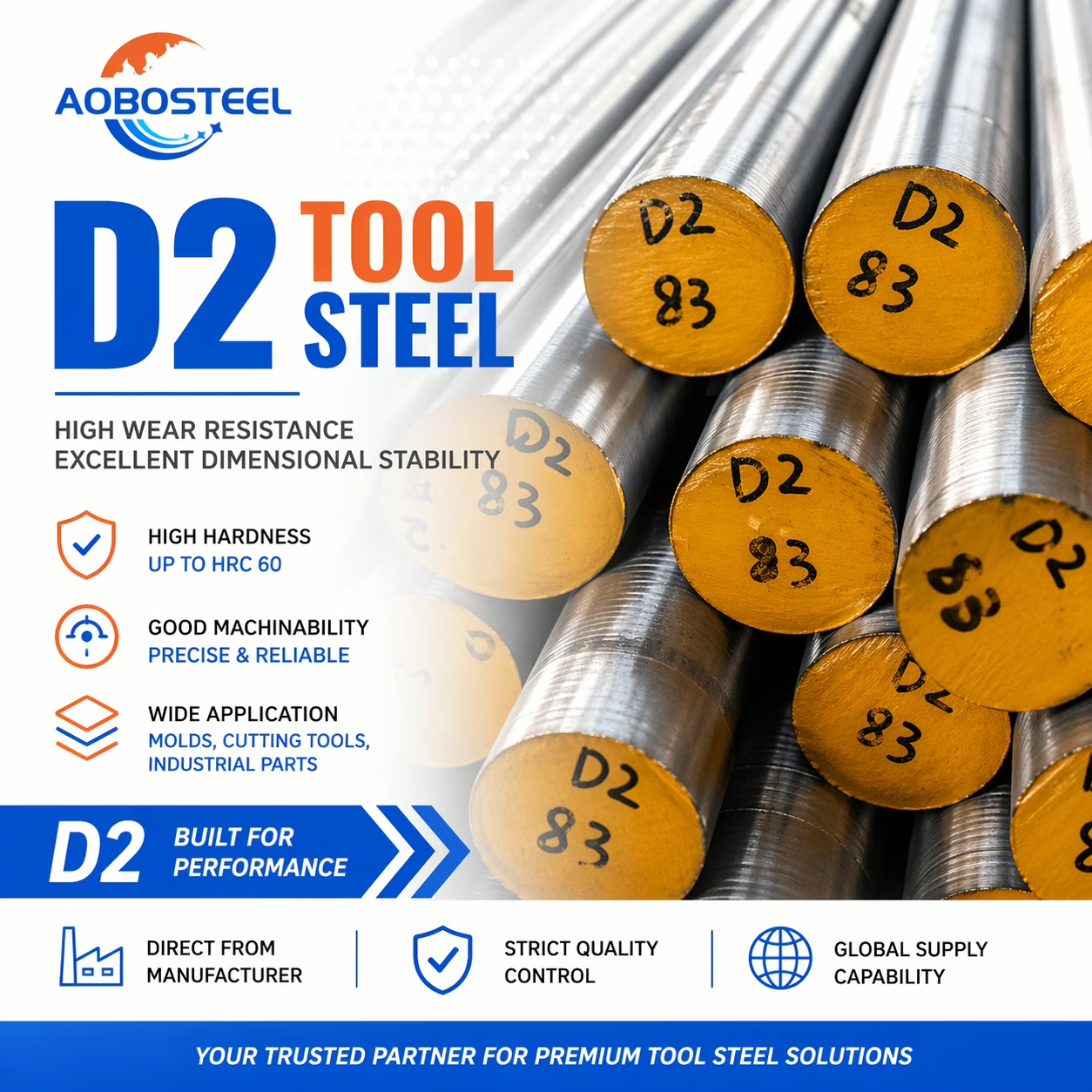
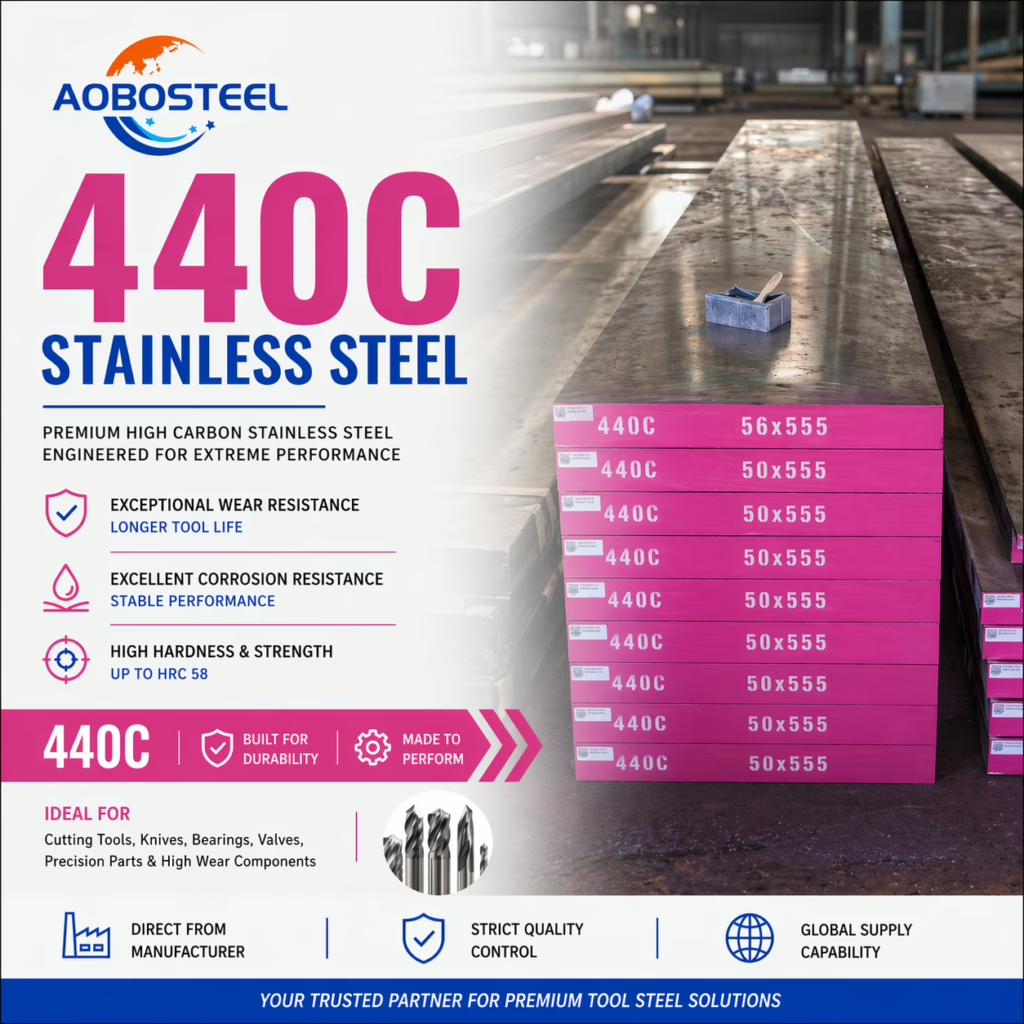
Aobo Steel supplies both D2 tool steel for wear-resistant tooling and 440C stainless steel for corrosion-resistant components.
You can view our product pages for D2 tool steel and 440C stainless steel, or contact [email protected] for grade selection and quotation support.
FAQ
D2 is better suited when the main requirements are dry abrasive wear resistance and long tool life. 440C is better when the part needs high hardness and corrosion resistance. They are not direct replacements for each other.
The main difference is the working environment. D2 is a cold-work tool steel for dry wear-dominated tooling. 440C is a martensitic stainless steel for parts that need hardness and rust resistance.
D2 generally exhibits better wear resistance under dry abrasive conditions due to its higher carbide volume. This makes it more suitable for dies, punches, shear blades, slitter knives, and other cold-work tooling.
440C has better corrosion resistance. D2 contains high chromium, but much of that chromium is tied up in carbides, so D2 does not behave like a true stainless steel in real service conditions.
Only in dry applications where corrosion resistance is not important. If the part is exposed to moisture, cleaning agents, mild chemicals, or rust-sensitive service conditions, 440C is usually the safer choice.
Only when corrosion resistance is more important than maximum dry wear resistance. For long-run blanking dies, punches, shear blades, and dry abrasive tooling, D2 usually gives better tool life.
D2 is better for edge retention in dry cutting. 440C is better for corrosion resistance, lower maintenance, outdoor use, kitchen use, and humid environments.
No. D2 contains high chromium, but it is not a true stainless steel. It can resist staining better than plain carbon steels, but it can still rust in humid, wet, or chemically aggressive environments.
Usually no. 440C has good hardness and wear resistance, but it is normally selected for corrosion-sensitive precision parts, bearings, valve components, and stainless cutting tools rather than heavy dry wear-dominated dies.
Avoid D2 when the application involves heavy impact, stainless steel forming, hot work, corrosive environments, or welded fabrication. D2 performs best in dry cold-work applications where abrasive wear is the main problem.
Avoid 440C when the application requires high impact toughness, extreme corrosion resistance, high-temperature service, welded fabrication, or maximum dry abrasive wear resistance.