
Best Tool Steels for Deep Drawing Dies
The best tool steels for deep drawing dies are D2/1.2379/SKD11, A2/1.2363/SKD12, O1/1.2510, O2/1.2842, O6, M2/1.3343/SKH51, and M4. The right choice depends on production volume, sheet material, drawing severity, and the die’s failure mode. For long-run dies with abrasive wear, D2 is usually the first choice. For better toughness and dimensional stability, A2 is more suitable. For short- to medium-production runs, O1 and O2 can work well. When galling, material pickup, or severe sliding wear becomes the main problem, O6, M2, or M4 may perform better.
Quick Selection Guide for Deep Drawing Die Steel
The table below provides a quick answer to common deep-drawing die conditions. It helps compare tool steels by wear resistance, toughness, galling risk, production volume, and drawing severity.
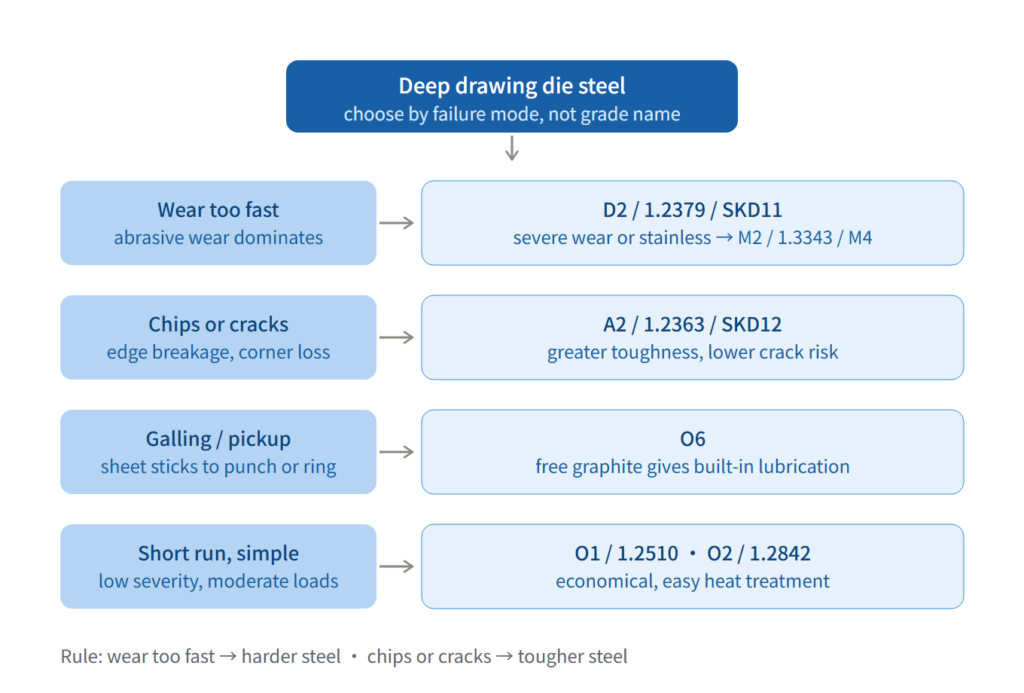
deep-drawing-die-steel-selection-flowchart
| Deep Drawing Condition | Better Tool Steel Choice | Why |
|---|---|---|
| Long-run production with abrasive wear | D2 / 1.2379 / SKD11 | Strong wear resistance and compressive strength |
| Drawing punches and draw rings under high friction | D2 | Good resistance to repeated sliding contact |
| Need better toughness and dimensional stability | A2 / 1.2363 / SKD12 | Better balance than high-carbon, high-chromium steels |
| Short to medium production runs | O1 / 1.2510 or O2 / 1.2842 | Practical cost-performance |
| Galling or sliding wear | O6 | Graphitic carbon helps reduce sticking |
| Severe drawing or abrasive sheet materials | M2 / 1.3343 / SKH51 or M4 | Higher wear resistance and compressive strength |
| Stainless steel drawing with material pickup | M2, O6, or low-chromium tool steel | Better control of adhesive wear |
| Simple short-run drawing dies | W-series steels | Lower-cost option for less demanding work |
| Very large drawing dies | Cast steel, gray iron, or ductile iron body | More practical for large die construction |
D2 is not always better than A2. M2 is not always necessary. O1 is not always too weak. The correct steel depends on how the die works and how it fails. Forming, drawing and bending dies are compared grade by grade in the forming, drawing and bending die steel selection guide.
Equivalent Grades Used in Deep Drawing Dies
Deep drawing die steel may appear under different standard names. Buyers may search by AISI, DIN/W.Nr., JIS, or local equivalent grades. The table below helps connect the common names used when selecting deep-drawing die materials.
| Common Grade | DIN / W.Nr. | JIS | Main Role in Deep Drawing Dies |
|---|---|---|---|
| D2 | 1.2379 | SKD11 | Long-run drawing dies, punches, draw rings, high abrasive wear |
| D3 | 1.2080 | SKD1 | High wear resistance and compressive strength |
| A2 | 1.2363 | SKD12 | Better toughness and dimensional stability than D-series steels |
| O1 | 1.2510 | SKS3 | Short to medium runs and simpler dies |
| O2 | 1.2842 | — | Short to medium runs and auxiliary tooling parts |
| O6 | — | — | Sliding wear and galling-prone applications |
| M2 | 1.3343 | SKH51 | Severe drawing, high wear, and galling-sensitive cases |
| M4 | — | — | Severe wear and high-load drawing conditions |
This table supports grade recognition. It should not replace the main selection rule. The die failure mode still decides the best material direction.
What Makes Deep Drawing Dies Difficult for Tool Steel?
Deep-drawing dies face high sliding friction, compressive loads, and surface contact pressure. The punch pushes the sheet metal into the die cavity, while the draw ring and blankholder control material flow. This creates wear, galling, cracking risk, and dimensional stability problems.
A deep drawing die steel must usually provide:
| Requirement | Why It Matters |
|---|---|
| Wear resistance | The sheet slides against the die surface under pressure |
| Compressive strength | Punches and draw rings must resist deformation |
| Toughness | Reduces chipping, cracking, and brittle failure |
| Dimensional stability | Helps the die keep shape after heat treatment |
| Galling resistance | Important when drawing stainless steel, aluminum, or sticky materials |
When Is D2 the Best Choice for Deep Drawing Dies?
D2 / 1.2379 / SKD11 is usually the best general choice when abrasive wear controls tool life, and the production run is long. It suits applications such as drawing punches, drawing rings, and high-friction working surfaces that require strong wear resistance and compressive strength.
D2 belongs to the high-carbon, high-chromium cold-work steel group. Its carbide-rich structure gives strong abrasion resistance and helps extend the interval between regrinding. This is why D2 is often selected for long-run deep drawing dies.
D2 does not solve every deep drawing problem. If the die chips, cracks, or galls during stainless steel drawing, the problem may not be abrasive wear. In that case, A2, M2, O6, or a lower-chromium tool steel may be a better direction.
Use D2 when the die wears gradually under repeated friction.
Replace D2 when the die fails by cracking, chipping, galling, or material pickup.
When Should You Choose A2 Instead of D2?
Choose A2 / 1.2363 / SKD12 instead of D2 when the deep-drawing die requires greater toughness, safer heat treatment, and better dimensional stability over maximum abrasive wear resistance.
A2 offers a balanced compromise between wear resistance and toughness. It is useful when the extreme wear resistance of D-series steel is not required, but the die still needs resistance to deformation and a reduced risk of cracking.
A2 is not simply a weaker D2. It solves a different problem. D2 focuses on wear. A2 focuses on balance.
Choose A2 when D2 is too crack-sensitive or when dimensional stability matters more.
Replace A2 with D2 when abrasive wear becomes the primary failure mode during extended production.
Are O1 and O2 Enough for Short-Run Deep Drawing Dies?
O1 / 1.2510 and O2 / 1.2842 can work for short- to medium-length production runs when the drawing conditions are moderate and extreme wear resistance is not required.
O-series steels provide useful hardness, sufficient toughness, and practical cost-effectiveness for many less-severe tooling applications. O1 and O2 can be used for deep drawing dies, punches, and related tooling. O2 may also be used for auxiliary parts such as ejectors and blankholders in some friction-heavy operations.
O1 and O2 become weak choices when production volume increases, wear becomes too fast, or heat-treatment distortion becomes a problem.
Use O1 or O2 when the job is short-run, simple, or moderate in severity.
Replace O1 or O2 with A2 or D2 when tool life, stability, or wear resistance becomes insufficient.
When Does O6 Make Sense for Galling Problems?
O6 makes sense for deep-drawing dies when the drawn sheet sticks to the punch, draw ring, or blankholder contact surface, leading to galling, material pickup, scratches, or poor surface finish. In this situation, the main problem is adhesive wear rather than simple abrasive wear.
O6 can help because its free graphite provides a built-in lubricating effect, reducing sliding friction during drawing. This makes it useful when galling becomes more serious than normal die wear.
O6 should not replace D2 in every long-run deep drawing die. If the punch or draw ring primarily fails due to abrasive wear, D2 or high-speed steel may still be preferable. O6 is more relevant when sticking, pickup, and surface damage are the main problems.
Use O6 when galling and material pickup are present on deep-drawing die contact surfaces.
Do not use O6 as the default answer when the main failure is long-run abrasive wear.
When Should You Upgrade to M2 / 1.3343 / SKH51 or M4?
Upgrade to M2 / 1.3343 / SKH51 or M4 when D2, A2, or O-series steels cannot provide enough wear resistance for severe deep drawing conditions.
High-speed steels such as M2 and M4 can handle severe drawing, abrasive sheet materials, high-pressure sliding contact, and demanding punch applications. M2 may also be considered when stainless steel drawing causes galling and material buildup, in which case D2 may not perform well.
M2 and M4 should not become default choices. If the drawing condition is not severe, D2 or A2 may provide better cost-performance.
Use M2 or M4 when severe wear, high pressure, or stainless steel galling makes ordinary cold-work steels insufficient.
Stick with D2 or A2 when the working conditions do not warrant high-speed steel.
What About W-Series Steels and Large Drawing Dies?
W-series steels such as W1, W2, and W5 may be used for simple, short-run drawing dies. They can provide a hard, wear-resistant outer case with a tougher core. W5 may be suitable for heavier stamping and drawing because chromium improves hardenability and wear resistance to some extent.
Their main weakness is heat-treatment risk. Water-hardening steels can distort or crack during quenching, especially in complex die shapes or uneven sections.
For very large drawing dies, solid tool steel may not be practical. Cast steel, gray cast iron, or ductile iron may be used for large die bodies, while high-wear surfaces may require hardened areas or tool-steel inserts.
This is a supporting point, not the main article’s focus. The main deep drawing die steel choices remain D2, A2, O1, O2, O6, M2, and M4.
When Should You Replace One Tool Steel with Another in Deep Drawing Dies?
A deep-drawing die should use a different tool steel when the current steel no longer matches the failure mode. Fast wear, chipping, cracking, galling, heat-treatment distortion, and increased production volume are the main reasons to change from one steel to another.
When Aobo Steel reviews a deep-drawing die material inquiry, the useful information includes the current die problem, the drawn sheet material, the production volume, the required size, and whether the die fails due to wear, cracking, galling, or distortion.
| Problemd | Steels | Replace With | Reason |
|---|---|---|---|
| Die wears too fast in short or medium runs | O1 / O2 | A2 or D2 | Better wear resistance and more stable die life |
| A2 loses tolerance in long production | A2 | D2 | Higher abrasive wear resistance and compressive strength |
| D2 still wears too fast in severe drawing | D2 | M2 or M4 | Higher wear resistance for severe conditions |
| D2 chips or cracks | D2 | A2 | Better toughness and lower brittle failure risk |
| D2 galls during stainless steel drawing | D2 | M2, O6, or low-chromium tool steel | Better resistance to adhesive wear and material pickup |
| O-series or W-series die distorts after hardening | O1 / O2 / W1 / W2 | A2 or D2 | Air-hardening steels give better dimensional stability |
| Large solid tool steel die costs too much | Solid tool steel | Cast steel, gray iron, or ductile iron body | More practical for large die construction |
This replacement logic matters more than a simple steel ranking. If the die wears too quickly, move toward a higher-wear-resistance option. If the die cracks, move toward higher toughness. If the die galls, focus on adhesive wear. If the die distorts, choose a more stable hardening route.
Deep drawing die steel grades and working hardness
A compact view of the same choice, read as grade, the hardness it runs at in a drawing die, and the one advantage it is chosen for.
| Tool Steel Grade | Typical Hardness | Primary Advantage for Deep Drawing |
|---|---|---|
| AISI D2 | 58–62 HRC | High wear resistance for long production runs |
| AISI O6 | 58–62 HRC | Reduced friction and strong resistance to galling |
| AISI A2 | 57–60 HRC | Better toughness and dimensional stability |
| AISI M4 | 60–64 HRC | Maximum wear resistance under severe conditions |
Common Mistakes When Choosing Tool Steel for Deep Drawing Dies
The most common mistake is choosing based on a steel grade’s reputation rather than on failure mode. The clearance, radii and drawing force the die is built to are collected in the deep drawing clearance and radii chart. A harder or more expensive steel does not solve wear, cracking, galling, or distortion.
| Mistake | Better Thinking |
|---|---|
| Choosing the hardest steel first | Check whether the real problem is wear, cracking, or galling |
| Using D2 for every long-run die | D2 may fail when galling or chipping controls tool life |
| Ignoring sheet material | Stainless steel and aluminum can create adhesive wear problems |
| Treating short-run and mass production the same | O1/O2 may work for short runs but fail in long production |
| Solving cracking with higher wear resistance | A cracked die usually needs more toughness |
Aobo Steel often sees material discussions start with “Which grade is better?” A better question is: “How is the die failing?” That question leads to a more reliable choice of steel.
Where to go next
Related selection pages on this site: O2 Tool Steel | 1.2842; Selection of Tool Steels for Forming & Drawing; O2 Tool Steel Heat Treatment Guide; Selection of Tool Steel for Tube & Pipe Mill Rolls | D2, A2, H13.