
Best Tool Steels for Cold Extrusion Dies
For high-pressure cold extrusion inserts, M2, M4, T15, D2, D3, D4, and A2 are common choices. For dies, bases, containers, shrink rings, and retainers, tougher steels such as A2, S1, L6, H11, and H13 are more suitable.
The simple rule is to use hard, wear-resistant steels for the working insert. Use tougher steels for the support structure.
Quick Selection Table for Cold Extrusion Dies
| Die Position / Working Condition | Main Failure Risk | Recommended Tool Steels | Typical Hardness | Selection Reason |
| Severe steel cold extrusion inserts | Plastic deformation, abrasive wear | M2, M4, T15 | 60–67 HRC | High compressive strength and strong wear resistance |
| General long-run cold extrusion inserts | Wear, dimensional change | D2, D3, D4 | 58–64 HRC | Good abrasion resistance, stability, and cost-performance |
| Inserts with higher cracking risk | Chipping, cracking | A2 | 56–62 HRC | Better toughness than D-series steels |
| Aluminum or softer non-ferrous extrusion dies | Moderate wear, cost control | A2, O1, O2, D2 | 56–62 HRC | Enough wear resistance without unnecessary material cost |
| Die bases, containers, support blocks | Cracking, mechanical stress | A2, S1, L6 | Application-dependent | Higher toughness and support strength |
| Shrink rings and retainers | Bursting pressure, splitting | H11, H13 | 46–48 HRC | Tough support for high-hardness inserts |
Why Cold Extrusion Dies Need Different Tool Steels
Cold extrusion forces metal to flow at room temperature. The die must resist high compressive stress, friction, and internal pressure. In severe applications, compressive stress can exceed 350 ksi (about 2400 MPa).
Different die parts carry different loads.
| Failure Risk | Common Position | Steel Requirement |
| Abrasive wear | Insert, punch, working surface | High hardness and carbide-supported wear resistance |
| Plastic deformation | Insert under forming pressure | High compressive strength |
| Chipping or cracking | Insert edge, sharp corner, unsupported area | Better toughness and proper die support |
| Bursting failure | Insert, container, shrink ring area | Tough outer support and compressive pre-stress |
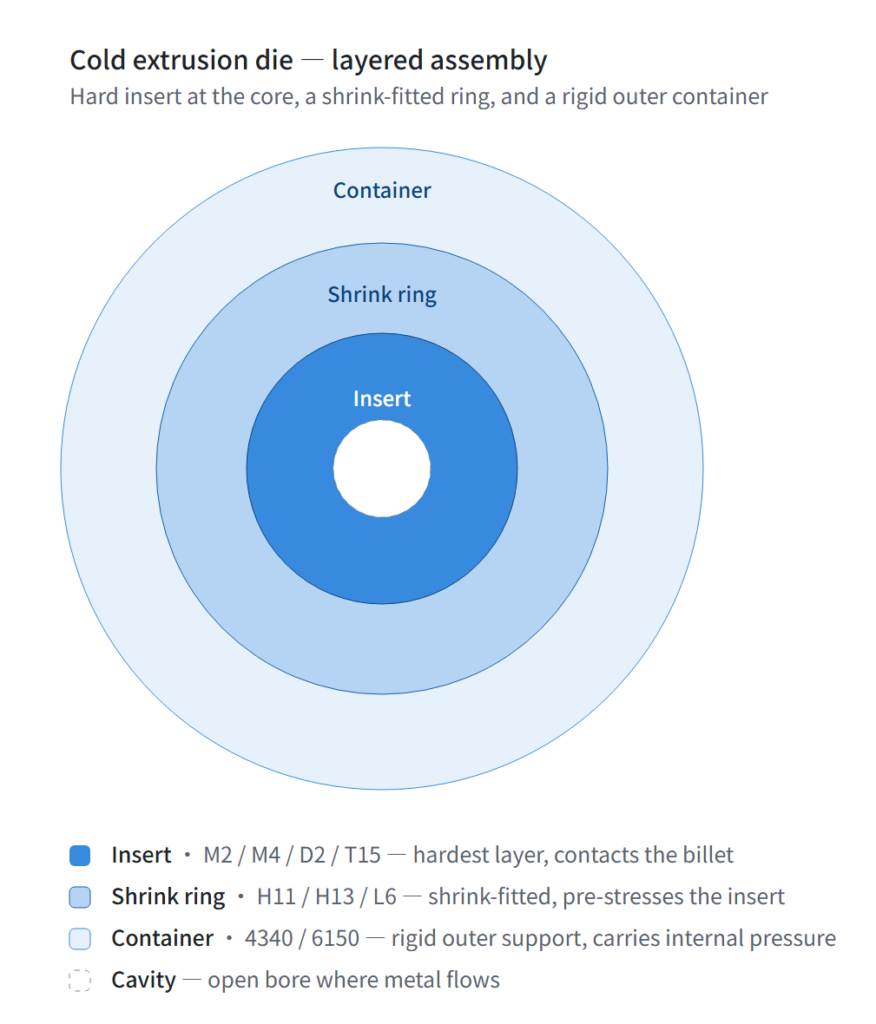
This is why cold extrusion dies often use a hard insert together with a tougher outer support structure. The insert handles wear and forming pressure. The support structure reduces the risk of cracking, splitting, and bursting.
Tool Steels for Cold Extrusion Inserts
Cold extrusion inserts need high hardness, compressive strength, wear resistance, and dimensional stability. The right insert material depends on pressure level, production volume, workpiece material, and cracking risk.
M2, M4, and T15 for Severe Cold Extrusion Inserts
High-speed tool steels are strong choices for severe cold extrusion inserts, especially for steel extrusion. They contain strong carbide-forming elements such as molybdenum, tungsten, and vanadium. These carbides improve wear resistance and compressive strength.
| Grade | Best Use Direction | Main Advantage | Limitation |
| M2 | Severe cold extrusion inserts | Balanced compressive strength and wear resistance | More costly than D-series steels |
| M4 | Heavier loads and longer runs | Higher wear resistance than M2 | Needs good die support |
| T15 | Extreme abrasive wear | Very high hardness and wear resistance | More sensitive to cracking |
M2 is the balanced high-speed steel choice. It is suitable when D2 does not provide enough die life under high pressure or heavy wear.
M4 is used when M2 is not enough. It gives stronger wear resistance and is suitable for longer production runs or more abrasive extrusion conditions.
T15 is the extreme wear-resistance choice. It can work at very high hardness, often around 65–67 HRC. However, high hardness also increases the risk of cracking. T15 inserts need strong support, accurate heat treatment, and proper shrink-ring design.
High-speed steels should usually be used as inserts rather than as the full die body. Their value is concentrated at the working surface.
D2, D3, and D4 for Long-Run Cold Extrusion Inserts
D-series cold-work tool steels are widely used for cold-extrusion inserts. Their high carbon and chromium content forms hard chromium carbides, which improve abrasion resistance during cold metal flow.
| Grade | Best Use Direction | Main Advantage | Limitation |
| D2 | General long-run cold extrusion inserts | Good balance of wear resistance, stability, and cost | Lower toughness than A2, S1, H11, or H13 |
| D3 | High-wear insert applications | Strong abrasion resistance | Needs good support because toughness is limited |
| D4 | Harder-wearing insert applications | High hardness and strong wear resistance | Not suitable where cracking risk is high |
D2 is often the most practical D-series choice. It gives good wear resistance, dimensional stability, and cost-performance. Its air-hardening behavior also helps reduce heat treatment distortion compared with oil- or water-hardening steels.
D3 is suitable when abrasive wear is the primary failure mode, and the die design already controls the risk of cracking.
D4 can be used when higher hardness and stronger wear resistance are needed. Like D3, it requires proper support because high-carbon, high-chromium steels are not ideal for impact or bursting conditions.
When pressure and wear become too severe for D-series steels, M2, M4, or T15 are stronger insert choices.
A2 for Inserts with Higher Cracking Risk
A2 is useful when the insert still needs wear resistance but also faces a higher risk of cracking or chipping.
Compared with D2, A2 has better toughness but lower abrasion resistance. This makes it suitable for inserts where D2 may be too brittle, especially when sharp corners, poor support, or moderate impact loads are present.
A2 is not the first choice for maximum wear life. Its value lies in the balance among toughness, dimensional stability, and moderate wear resistance.
O1 and O2 for Less Severe Cold Extrusion
O1 and O2 can be used in less severe cold extrusion or non-ferrous forming. They are more economical than high-speed steels and certain high-alloy cold-work steels.
They are not suitable for severe steel extrusion. Their role is mainly in moderate-load applications, where tooling costs matter more than maximum die life.
Tool Steels for Aluminum and Softer Non-Ferrous Cold Extrusion
Aluminum and softer non-ferrous metals usually place lower loads on the die than steel. These applications still need wear resistance, but they may not warrant the expense of high-speed steels.
| Application Condition | Suitable Tool Steels | Reason |
| Moderate non-ferrous extrusion | O1, O2 | Lower tooling cost for less severe work |
| Better toughness and stability required | A2 | Balanced toughness, stability, and wear resistance |
| Longer production life required | D2 | Better wear resistance and dimensional stability |
A2 is often a good choice when the die needs a balance of toughness, wear resistance, and dimensional stability.
O1 and O2 are economical options for moderate tooling conditions. Related page: O1 vs O2 Tool Steel: Which Cold Work Steel Should You Choose?
D2 can be used when better wear resistance and longer production life are needed. It is more suitable than O-series steels when dimensional stability and abrasion resistance become more important.
For aluminum and softer non-ferrous extrusion, the best choice is not always the hardest steel. It is the grade that provides sufficient wear resistance without unnecessary cost or risk of cracking.
Tool Steels for Die Bases, Containers, and Support Components
The die bases, containers, and support components do not perform the same job as the insert. They hold the insert, support the forming load, and reduce the risk of cracking or bursting.
These parts need toughness and support strength more than maximum wear resistance.
| Component | Recommended Tool Steels | Main Requirement |
| Die bases | A2, S1, L6 | Toughness and mechanical support |
| Containers | A2, L6, H11, H13 | Support strength and cracking resistance |
| Heavy support parts | S1, L6 | Resistance to impact and mechanical stress |
A2 is useful when the support part still needs some wear resistance, but also needs better toughness than D2.
S1 is a shock-resisting tool steel. It is suitable for components exposed to heavy loads, impact, or cracking risk. It should not replace M2, M4, T15, D2, or D4 in high-wear inserts.
L6 is used when toughness is the main requirement. It can work well in die bases, containers, and heavy support components. It is not a wear-resistant steel for severe inserts, but it can help the die assembly survive high mechanical stress.
These tougher steels protect the die assembly from sudden failure. They are especially useful when a hard insert would be too brittle without external support.
H11 and H13 for Shrink Rings and Retainers
Shrink rings and retainers are critical in cold extrusion die assemblies. They keep the insert under compression, reducing the risk of splitting under internal pressure.
| Grade | Best Use Direction | Main Reason |
| H11 | Shrink rings, retainers, tough support parts | High toughness and cracking resistance |
| H13 | Shrink rings, retainers, containers | Strength, toughness, and deep hardenability |
H11 is useful when the support structure needs high toughness and resistance to cracking.
H13 is commonly known as a hot-work tool steel, but it also performs well in cold-extrusion support structures. It offers strength, toughness, and deep hardenability, making it suitable for shrink rings, retainers, and containers.
H11 and H13 are not selected because they are more wear-resistant than M2 or D2. They are selected because they can support brittle, high-hardness inserts under high internal pressure.
High-strength alloy steels such as 4340 and 6150 are also used for some retaining components, but they are not tool steels. For a tool-steel-focused selection guide, H11 and H13 are cleaner recommendations. Related page: H13 vs H11 Tool Steel
Insert Steel vs Support Steel: The Main Selection Rule
Cold extrusion dies fail when the wrong steel is used in the wrong position. M2, M4, T15, D2, D3, and D4 can provide strong wear resistance, but they may crack when used in support positions due to insufficient toughness. S1, L6, H11, and H13 can resist cracking and bursting, but they usually cannot match the abrasive wear resistance of high-speed steels or D-series steels.
| If the main problem is… | Choose mainly for… | Better Steel Direction |
| Insert wears too fast | Wear resistance and hardness | D2, D3, D4, M2, M4, T15 |
| Insert loses shape under pressure | Compressive strength | M2, M4, T15 |
| Insert chips or cracks | Toughness and support | A2, better die support, proper shrink ring design |
| Die assembly splits or bursts | Support strength and toughness | H11, H13, S1, L6 |
| Cost is too high for non-ferrous work | Enough wear resistance at lower cost | A2, O1, O2, D2 |
The best cold extrusion die design usually combines a hard-working insert with a tougher support structure.
Final Recommendation
For severe-cold extrusion inserts, choose M2, M4, or T15 when compressive strength and wear resistance are the primary requirements.
For general long-run cold extrusion inserts, D2, D3, and D4 are practical choices. D2 gives the best overall balance, while D3 and D4 are stronger options when abrasion is more severe.
For inserts with a higher risk of cracking, A2 is often safer than D-series steels because it offers better toughness.
For aluminum and other softer non-ferrous extrusions, A2, O1, O2, and D2 can be more cost-effective than high-speed steels.
For dies, bases, containers, shrink rings, and retainers, use tougher steels such as A2, S1, L6, H11, and H13.
The key is not to select the hardest steel for every part. Select the steel based on the die position and the primary failure risk. Hard steels control wear and deformation. Tough steels control cracking and bursting.