
52100 Steel Properties: Composition, Hardness & Equivalents
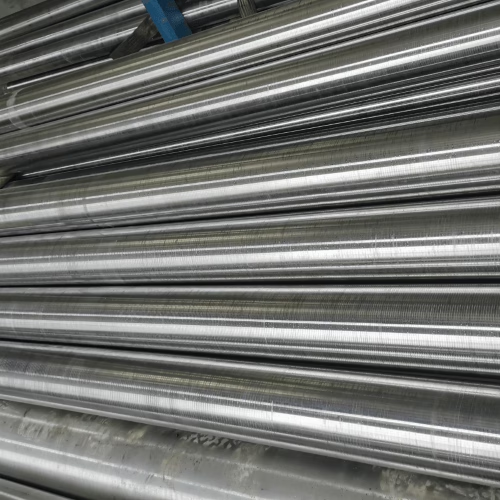
SAE/AISI 52100 steel is an alloy steel occupying a central position in the field of materials science and engineering, particularly in the manufacture of precision mechanical components. It is considered the classic rolling bearing steel, and the comprehensive properties of 52100 steel serve as the benchmark against which the composition of other similar steels is measured and evaluated.
As a high-carbon, low-alloy chromium steel, 52100 steel’s core advantage lies in its exceptionally high hardness and superior wear resistance. These properties make it an indispensable choice for applications requiring long-term, high-intensity operation.
Defining 52100: Chemical Composition
As a low-alloy steel, 52100 falls under the 5100 series, which are specified low-alloy steels containing more than 0.30% C and adaptable to austempering processes. It is specifically used in wear applications without requiring carburizing.
Hardness and Heat Treatment
The exceptional fatigue and wear resistance of 52100 steel stems from its heat treatment. The ultimate goal of heat treatment is to optimize its internal microstructure, transforming it into a hard martensitic structure that meets the stringent demands of rolling contact fatigue under high loads.
Microstructure and Treatment Parameters
The standard heat treatment process primarily consists of three key steps:
- Austenitizing: the first step. 52100 steel must be heated to a very narrow and precise temperature range of 855 ± 5 °C. This temperature range ensures complete austenitization of the steel and controls the amount of retained austenite after quenching to a reasonable level. Special attention must be paid to strictly avoiding temperatures exceeding 860°C (1600°F). Overheating produces excessive retained austenite, which readily forms coarse, needle-like martensite with microcracks during subsequent quenching. This is highly detrimental to the component’s final strength and service life.
- Quenching: Immediately after austenitization, perform oil quenching to obtain a high-hardness martensitic structure.
- Tempering: Steel hardened by quenching becomes hard and brittle, necessitating immediate tempering to prevent cracking. 52100 steel is typically low-temperature tempered within the 180–250°C range to relieve internal stresses, enhance toughness, and maintain high hardness.
After undergoing this complete set of processes, 52100 steel achieves its ideal properties. Its microstructure primarily consists of a mildly tempered martensitic matrix, uniformly distributed residual carbides, and a small amount of less than 5% retained austenite. The undissolved residual carbides contribute to enhanced wear resistance.
Target Hardness Levels
52100 steel can achieve high hardness through heat treatment, a key factor in its suitability as a high-performance bearing steel. Its hardness value is not fixed but varies within a certain range depending on the specific application and heat treatment process.
After standard heat treatment, the Rockwell hardness (HRC) of 52100 steel typically ranges from 55 to 60 HRC, or 62 to 64 HRC under specific processes.
Hardness targets are also fine-tuned according to the end application. For instance, in conventional bearing applications, surface hardness is typically controlled around 62 HRC. However, when manufacturing precision molds—such as those for consumable electrode vacuum melting—hardness targets are more precisely controlled to 59-61 HRC to balance hardness with mold longevity.
At the micro level, its hardness also exhibits variations. Research indicates that after machining, the material’s near-surface hardness (approximately 900 HV0.025) is significantly higher than its overall internal hardness (approximately 750 HV0.025), demonstrating surface strengthening during machining1.
Key Mechanical Properties
Elastic Modulus and Strength
- Stiffness: The Young’s modulus, or elastic modulus, of 52100 steel is 210 GPa.
- Strength: The strength of 52100 steel must be distinguished based on its heat treatment condition. In the annealed state, its strength is intentionally reduced to facilitate machining. At this stage, its tensile strength is approximately 379 MPa, and its yield strength is about 165 MPa. When quenched, its ultimate strength at the fracture point is 590 MPa.
Toughness and Fracture Resistance
High hardness is typically accompanied by low toughness. Even after standard tempering at 200°C, the overall toughness of quenched-and-tempered 52100 steel remains low. Its fracture toughness (K_Ic) typically ranges only between 15–25 MPa m1/2, indicating relatively low resistance to crack propagation2.
Weldability
AISI 52100 steel is highly prone to cracking during quenching due to its high carbon content, and is therefore nonweldable.
Equivalent Grades and Designations
As an internationally recognized material, SAE 52100 has multiple equivalent designations across different national and industry standards.
| Standard (Country/Region) | Equivalent Grade | W-Nr. (German Werkstoff) |
| DIN / EN (Germany / Europe) | 100Cr6 | 1.3505 |
| JIS (Japan) | SUJ2 | – |
| GB (China) | GCr15 | – |
| BS (United Kingdom) | EN31 (also 534A99 / 535A99) | – |
| ISO (International) | 100Cr6 | 1.3505 |
| UNS (USA) | G52986 | – |
| GOST (Russia) | ShKh15 | – |
FAQ
After standard heat treatment, the Rockwell hardness (HRC) of 52100 steel typically ranges from 55 to 60 HRC, though specific processes can achieve 62 to 64 HRC.
52100 is defined as a high-carbon, low-alloy chromium steel and is considered the classic rolling bearing steel. It falls under the 5100 series, containing more than 0.30% Carbon.
52100 steel must be heated to the precise temperature range of 855 ± 5 °C for complete austenitization. It is strictly critical to avoid temperatures exceeding 860 °C.
52100 steel is typically low-temperature tempered within the 180–250°C range. Tempering is essential to relieve internal stresses, enhance toughness, and prevent cracking after quenching.
The standard European (EN) and German (DIN) equivalent grade for 52100 steel is 100Cr6, corresponding to the W-Nr. designation 1.3505.
52100 is an indispensable choice for conventional bearing applications, precision mechanical components, and precision molds, due to its superior wear resistance and ability to sustain high-intensity operation.
The Japanese Industrial Standards equivalent designation for SAE 52100 steel is SUJ2.
The Young’s modulus, or elastic modulus, which measures the stiffness of 52100 steel, is 210 GPa.
No, AISI 52100 steel is classified as nonweldable. It is highly prone to cracking during quenching because of its high carbon content.