
D2 Tool Steel Properties
D2 tool steel is a high-carbon, high-chromium cold-work tool steel used when abrasive wear resistance, working hardness, and dimensional stability matter more than impact toughness.
Hardened D2 is normally used around 58-60 HRC, while annealed D2 is supplied around 217-255 HB for machining before final heat treatment.
D2 Tool Steel Available from Aobo Steel
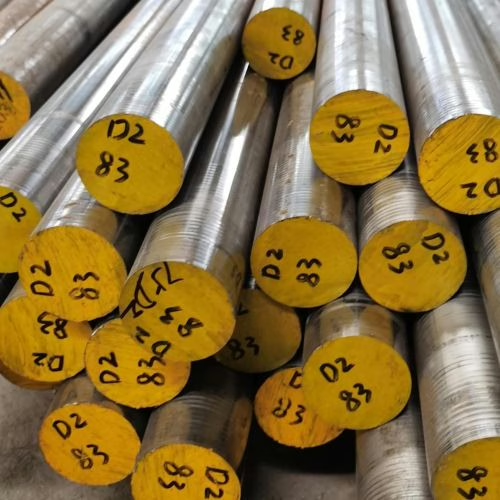
D2 performs best in blanking dies, forming dies, punches, slitter knives, shear blades, thread-rolling dies, gauges, and wear-resistant cold-work tooling. It is the wrong choice when the tool fails mainly from heavy impact, severe chipping, corrosion, galling, or high-temperature thermal fatigue.
What Are the Main Properties of D2 Tool Steel?
The main properties of D2 tool steel are high abrasive-wear resistance, high hardness, good dimensional stability, high compressive strength, and moderate-to-low toughness.
D2 is commonly used at about 58-60 HRC after hardening and tempering. It suits cold-work tools that fail primarily from wear, such as blanking dies, punches, slitter knives, shear blades, and thread-rolling dies.
D2 Tool Steel Properties at a Glance
| Property | Typical D2 Performance | Practical Meaning |
|---|---|---|
| Steel type | High-carbon, high-chromium cold-work tool steel | Used for wear-resistant cold-work tools |
| Main designations | D2 / 1.2379 / SKD11 / Cr12Mo1V1 | Common global equivalent grade family |
| Annealed hardness | Approx. 217-255 HB | Suitable for machining and stock preparation |
| As-quenched hardness | Approx. 64-65 HRC | Maximum hardness before tempering |
| Common working hardness | Approx. 58-60 HRC | Practical range for most D2 tooling |
| Wear resistance | High to very high | Strong in abrasive cold-work applications |
| Toughness | Moderate to low | Not ideal for shock-loaded tools |
| Dimensional stability | Good | Lower distortion than many oil-hardening grades |
| Machinability | Difficult | Carbides increase tool wear and grinding cost |
| Corrosion resistance | Limited | D2 is not stainless steel |
| Typical supply condition | Annealed | Usually machined before final heat treatment |
The key point is simple: D2 is a wear-resistant steel, not a toughness steel. Choose it when abrasive wear is the main failure mode.
What Is D2 Tool Steel?
D2 is an air-hardening, high-carbon high-chromium cold-work tool steel in the AISI D-series, also known as 1.2379 and SKD11. After heat treatment it forms a hard martensitic matrix with a high volume of chromium-rich carbides. These carbides give D2 strong abrasive wear resistance and lower toughness compared with grades such as A2 or S7.
D2 Steel Chemical Composition
The chemical composition of D2 explains most of its properties. High carbon and high chromium create hard carbides. Molybdenum improves hardenability and tempering response. Vanadium supports fine carbide formation and grain control.
| Element | Typical Range | Function in D2 Tool Steel |
|---|---|---|
| Carbon | 1.40-1.60% | Increases hardness and supports carbide formation |
| Chromium | 11.00-13.00% | Forms chromium carbides and improves hardenability |
| Molybdenum | 0.70-1.20% | Improves hardenability and tempering resistance |
| Vanadium | 0.50-1.10% | Supports wear resistance and grain control |
| Manganese | Up to about 0.60% | Supports hardenability |
| Silicon | Up to about 0.60% | Supports deoxidation and strength |
| Nickel | Up to about 0.30% | Usually residual or minor alloying element |
| Iron | Balance | Base metal |
The high carbon and chromium give D2 its main advantage: strong abrasive wear resistance. The same composition also creates its main weakness, reduced toughness. For full element limits by standard and grade equivalents, see the D2 steel composition page.
D2 Steel Physical Properties
The physical properties below are typical reference values for D2 / 1.2379 tool steel. Density, thermal conductivity, specific heat, and thermal expansion vary by steelmaker, test method, heat-treatment condition, and temperature range.
| Physical Property | Typical Value | Practical Meaning |
|---|---|---|
| Density | Approx. 7.67-7.80 g/cm³ | Useful for weight calculation and stock planning |
| Modulus of elasticity | Approx. 200-210 GPa | Indicates elastic stiffness under load |
| Specific heat | Approx. 460-470 J/kg·K | Relevant to heating and thermal response |
| Thermal conductivity | Approx. 20-24 W/m·K | Lower than plain carbon steel, so heating must be controlled |
| Coefficient of linear thermal expansion | Approx. 10.5-12.7 x 10⁻⁶/K | Important for heat treatment and precision tools |
| Magnetic behavior | Ferromagnetic | D2 is magnetic in normal tooling use |
The modulus of elasticity is often reported around 203 GPa. This is useful for understanding elastic stiffness, but it does not decide whether D2 is the right steel. In real tooling, wear resistance, toughness, hardness, dimensional stability, and tool support matter more.
Is D2 steel magnetic? Yes. D2 is ferromagnetic in the annealed and hardened conditions and behaves as a normal magnetic tool steel in service.
Critical Transformation Temperatures of D2 Steel
| Transformation Temperature | Typical Value | Meaning |
|---|---|---|
| Ac1 | Approx. 788°C | Austenite begins to form during heating |
| Ac3 | Approx. 845°C | Austenite transformation largely complete during heating |
| Ar1 | Approx. 769°C | Transformation begins during cooling |
| Ar3 | Approx. 744°C | Transformation largely complete during cooling |
D2 is austenitized well above these points during hardening.
D2 Steel Dimensional Stability
D2 is often selected when dimensional stability after heat treatment matters. When properly austenitized and air-quenched, D2 usually shows a very small size change, often around 0.0005 in./in. This is one reason it is used for precision dies, gauges, and tools with tight tolerances.
Dimensional change is not always uniform. Carbide orientation, tool geometry, sharp corners, uneven sections, austenitizing temperature, quenching method, and tempering all influence final movement. “Non-deforming” should be read as low distortion, not zero risk.
D2 Steel Workability and Machinability
D2 is difficult to machine and grind because it contains hard chromium-rich carbides. In the annealed condition it is machinable, but still more demanding than lower-alloy tool steels such as O1.
A commonly reported machinability rating for D2 is around 45, using a basic 1% carbon steel rated at 100 as the reference. This means D2 needs stronger tooling, tighter cutting parameters, and more grinding time.
| Workability Factor | D2 Behavior | Practical Meaning |
|---|---|---|
| Machinability | Difficult | Higher tool wear and longer machining time |
| Grindability | Difficult | Hard carbides increase grinding resistance |
| Annealed condition | Best condition for machining | D2 should be machined before hardening |
| Hardened condition | Very difficult to machine | Usually finished by grinding, EDM, or controlled finishing |
| Sulfurized D2 variants | Improved machinability | May improve chip breaking and surface finish in some mill products |
D2 Tool Steel Mechanical Properties
D2 mechanical properties depend heavily on heat treatment, final hardness, section size, tempering temperature, and tool design. For most tooling decisions, hardness, wear resistance, toughness, compressive strength, and dimensional stability are more useful than a single tensile number.
| Property | Typical D2 Behavior | Selection Meaning |
|---|---|---|
| Hardness | Commonly 58-60 HRC after hardening and tempering | Main working range for wear-resistant tools |
| Wear resistance | High to very high | Suitable for abrasive contact and long production runs |
| Toughness | Moderate to low | Risk of chipping under impact or poor support |
| Compressive strength | High when hardened | Useful for punches, dies, coining tools, and extrusion tools |
| Dimensional stability | Good after controlled heat treatment | Suitable for precision dies and gauges |
| Machinability | Difficult | Higher processing cost than A2 or O1 |
| Ductility | Low in hardened condition | Tool design should avoid sharp stress concentration |
Some tensile test data for forged D2 report an ultimate tensile strength of about 758 MPa, a yield strength of 350-411 MPa, and a modulus of elasticity of 203 GPa. These are not fixed design values, because D2 varies significantly with heat treatment and hardness.
What is the yield strength of D2 tool steel? Forged D2 is reported with a yield strength of about 350-411 MPa and an ultimate tensile strength of about 758 MPa in tensile testing. Final values depend on heat treatment, hardness, and section size.
D2 Hardness and Heat Treatment
D2 is supplied annealed at about 217-255 HB for machining. After hardening and tempering, most cold-work tools run at about 58-60 HRC, with as-quenched hardness reaching roughly 64-65 HRC before tempering.
Hardness should be matched to the tool’s failure mode, not pushed to maximum. Higher hardness improves wear resistance and compressive strength but reduces resistance to chipping. For application-specific hardness targets and tempering behavior, see the D2 steel hardness guide. For the full hardening sequence, including preheating, austenitizing, quenching, and double tempering, see the D2 tool steel heat treatment guide.
Aobo Steel supplies D2 in an annealed condition only. The heat-treatment process should be designed around tool size, geometry, final hardness, and service conditions.
Wear Resistance, Toughness, and Dimensional Stability
D2 is selected mainly for three properties: wear resistance, hardness stability, and dimensional control. Its weakness is toughness.
| Property | D2 Performance | Practical Selection Rule |
|---|---|---|
| Wear resistance | High to very high | Choose D2 when abrasive wear is the main failure mode |
| Toughness | Moderate to low | Avoid D2 when sudden impact or edge chipping is the main risk |
| Dimensional stability | Good | Choose D2 when size control after heat treatment matters |
| Compressive strength | High | Suitable for high-pressure cold-work tooling |
| Machinability | Difficult | Consider A2 or O1 when machining cost matters more than tool life |
D2 usually offers stronger abrasive wear resistance than A2, though A2 is tougher and easier to machine. Compared with O1, D2 generally gives better dimensional stability because it hardens by air cooling rather than oil quenching.
D2 Steel Applications
D2 is mainly used in cold-work tooling where abrasive wear, edge retention, compressive strength, and dimensional stability matter more than impact toughness.
| Application | Why D2 Is Used |
|---|---|
| Blanking dies | Resists abrasive wear and maintains cutting edges |
| Stamping dies | Suitable for long-run sheet-metal work |
| Punches | High hardness and compressive strength |
| Forming dies | Good resistance to sliding wear |
| Deep drawing dies | Useful when abrasion is more severe than impact |
| Slitter knives | Maintains edge under cold cutting conditions |
| Shear blades | Good wear resistance in light to medium cold shearing |
| Thread-rolling dies | Resists surface wear under repeated contact |
| Cold extrusion punches | Handles high compressive pressure |
| Gauges and precision tools | Good size stability after controlled heat treatment |
| Wear inserts and wear plates | Strong abrasion resistance in repeated contact |
D2 can be used in some specialized hot-trimming or abrasive molding work, but it is not a hot-work steel. For die casting, hot forging, or severe thermal fatigue, H13, H11, or other hot-work grades are more suitable.
For blanking dies, punches, slitter knives, shear blades, thread-rolling dies, and wear-resistant tooling, Aobo Steel supplies annealed D2 for machining and final heat treatment by the customer. See more wear-focused grades on the abrasive wear-resistant tool steel page.
When Should You Choose D2 Tool Steel?
Choose D2 when the tool needs long life in abrasive cold-work service and the conditions do not involve severe shock or corrosion.
| Choose D2 When | Why It Makes Sense |
|---|---|
| Abrasive wear is the main failure mode | D2 contains hard chromium-rich carbides |
| Production runs are long | Longer tool life can offset higher processing cost |
| Final hardness needs to be around 58-60 HRC | D2 works well in this range |
| Dimensional stability matters | Air-hardening reduces distortion risk |
| The tool faces high compressive pressure | Hardened D2 has strong compressive performance |
| The application is cold-work tooling | D2 is designed for dies, punches, blades, and wear inserts |
When You Should Not Choose D2 Tool Steel
D2’s advantage is wear resistance. Its risk is cracking, galling, corrosion, or heat-related failure. Avoid it when the application needs toughness, corrosion resistance, hot-work strength, or low-cost machining more than wear resistance.
| Avoid D2 When | Reason | Better Direction |
|---|---|---|
| Heavy shock or sudden impact is severe | D2 has limited toughness | S7 or other shock-resisting steels |
| Stainless-steel galling is severe | Adhesive wear and material pickup may occur | Coated tools, M2, or alternative tooling systems |
| Corrosion resistance is critical | D2 is not stainless steel | 440C or other stainless grades |
| High-temperature service or thermal fatigue is continuous | D2 is a cold-work steel | H13, H11, or other hot-work steels |
| Short-run tooling needs easy machining | D2 is harder and costlier to process | A2, O1, or lower-cost alternatives |
| Tool geometry has sharp stress concentration | D2 may chip or crack | Improve design or use a tougher grade |
| The part requires very complex machining | High carbide content raises cost | Easier-machining grades may reduce total cost |
A common mistake is choosing D2 only because it is hard. Hardness helps only when the failure mode is wear or compressive deformation. It does not solve shock cracking, galling, corrosion, poor support, or poor tool design.
D2 Steel Equivalent Grades
D2 is used globally under several equivalent or closely comparable designations. The final standard and mill certificate should always be checked before substitution. For a full cross-reference, see the tool steel equivalent grades page.
| Standard / Country | Equivalent Grade |
|---|---|
| AISI / SAE | D2 |
| ASTM | ASTM A681 D2 |
| UNS | T30402 |
| DIN / W.-Nr. | 1.2379 |
| EN / DIN designation | X153CrMoV12 or X155CrMoV12-1 |
| JIS | SKD11 |
| China GB | Cr12Mo1V1 |
| British Standard | BD2 |
| ISO | 160CrMoV12 |
| Korea KS | STD11 |
Commercial names such as K110, SLD, DC11, XW-41, and XW-42 are often linked to the D2 / 1.2379 / SKD11 family. They should be checked against specifications, because chemical limits, cleanliness, carbide distribution, and production routes vary by manufacturer.
DC53 is often compared with D2 but is not a direct equivalent. It is a modified cold-work tool steel developed to improve toughness in some applications.
D2 vs A2, O1, S7, D3, 440C, and H13
Compare D2 with other grades by failure mode, not by hardness alone.
| Grade | Compared with D2 | Main Selection Difference |
|---|---|---|
| A2 | Tougher and easier to machine | Choose A2 when chipping risk is higher |
| O1 | Easier to machine and lower cost | Choose O1 for simpler tools and lower distortion demands |
| S7 | Much tougher | Choose S7 when impact resistance matters more than wear resistance |
| D3 | Higher wear resistance but lower toughness | Choose D3 only when abrasion is extreme and impact is low |
| 440C | Better corrosion resistance | Choose 440C when stainless behavior matters |
| H13 | Better hot-work performance | Choose H13 for heat checking, die casting, and hot-work service |
If abrasive wear dominates, D2 is often stronger than A2 and O1. If impact is the priority, A2 or S7 may be better. If corrosion dominates, 440C is more suitable. If heat checking or high-temperature service dominates, H13 or H11 should be considered.
Need D2 tool steel for wear-resistant tooling?
Aobo Steel supplies annealed D2 / 1.2379 / SKD11 tool steel for dies, punches, slitter knives, shear blades, gauges, wear plates, and cold-work tooling.