
H13 vs P20 Steel: Key Differences, Applications, and How to Choose
P20 is a prehardened plastic mold steel, usually supplied at about 28–32 HRC. It is designed for efficient machining, stable mold production, and controlled manufacturing cost. For standard plastic injection molds working under moderate conditions, P20 is often the practical choice. Application detail by mold type, including where P20 stops being suitable, is in the P20 tool steel applications guide.
In summary, select P20 for cost and efficiency, and H13 for heat and wear resistance.
H13 is a hot work tool steel. It is normally supplied in the annealed condition, machined first, and then heat-treated to the required working hardness. It is used when the tool must resist heat, thermal fatigue, abrasive wear, high pressure, and long production cycles.
H13 and P20 Steel Available from Aobo Steel
Aobo Steel supplies H13 hot-work tool steel and P20 prehardened plastic mold steel for die casting, hot-work tooling, plastic injection molds, mold bases, inserts, and mold components.
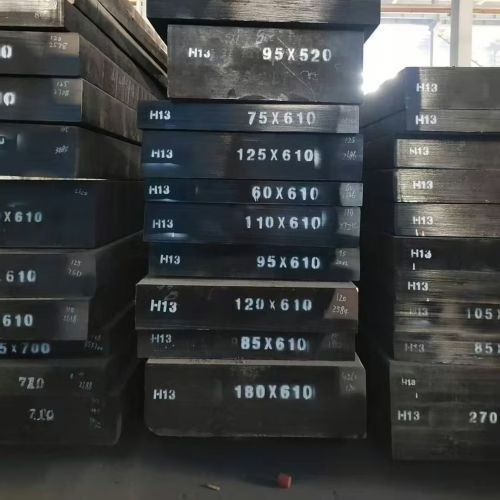
H13 | 1.2344 | SKD61
Hot-work tool steel for die casting dies, cavities, cores, inserts, hot-work wear, thermal fatigue resistance, and high-pressure production tooling.
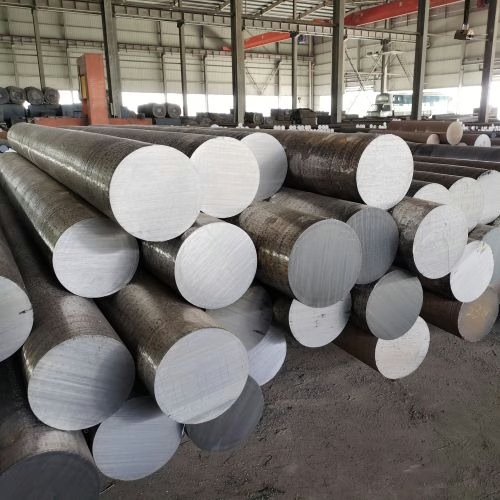
P20 | 1.2311 | 3Cr2Mo
Prehardened plastic mold steel for standard injection molds, mold bases, holders, backing plates, efficient machining, and cost-controlled mold production.
Core Differences Between H13 and P20
| Characteristic | H13 Steel | P20 Steel |
|---|---|---|
| Steel type | Hot work tool steel | Plastic mold steel |
| Common delivery condition | Annealed | Prehardened |
| Typical working hardness | 40–54 HRC after heat treatment | 28–32 HRC |
| Heat resistance | High | Low |
| Thermal fatigue resistance | High | Limited |
| Wear resistance | High after heat treatment | Moderate |
| Machinability | Medium | Excellent |
| Heat treatment requirement | Required for final performance | Usually not required after machining |
| Typical cost level | Higher | Lower |
| Best use | Die casting, hot work, high-wear mold parts | Standard plastic molds, holders, backing plates |
P20 delivers useful mold performance directly in its supplied prehardened condition. H13 develops its full performance only after proper heat treatment.
This difference affects not only hardness, but also machining route, delivery planning, distortion risk, tool life, and total mold cost.
H13 vs P20 Steel Equivalent Grades
When sourcing H13 or P20 internationally, equivalent grades are important because buyers may use AISI, DIN, JIS, GB, UNS, or local designations.
| Standard / Region | H13 Equivalent | P20 Equivalent |
|---|---|---|
| AISI / ASTM | H13 / ASTM A681 H13 | P20 / ASTM A681 P20 |
| UNS | T20813 | T51620 |
| DIN / W-Nr. | 1.2344 | 1.2311 |
| JIS | SKD61 | Commonly referenced through P20-type plastic mold steels |
| GB China | 4Cr5MoSiV1 | 3Cr2Mo |
| BS | BH13 / H13 | BS 4659 P20 reference |
| AFNOR | Z40CDV5 | Z 33 C 35 type reference |
| Common modified grades | H13 variants | 1.2738, 1.2312, 3Cr2MnNiMo |
For most international purchasing, the key cross-references are simple:
H13 is commonly matched with 1.2344, SKD61, and 4Cr5MoSiV1. P20 is commonly matched with 1.2311 and 3Cr2Mo.
Hardness, Heat Treatment, and Machinability
Hardness is one of the most searched differences between H13 and P20, but it should not be judged alone. The more important question is how the steel reaches its working condition.
| Item | H13 Steel | P20 Steel |
|---|---|---|
| Supplied condition | Annealed | Prehardened |
| Typical supplied hardness | Usually soft enough for machining | Usually 28–32 HRC |
| Working hardness | Usually 40–54 HRC after heat treatment | Usually used directly at supplied hardness |
| Machining route | Machine first, then heat treat | Machine and use directly |
| Distortion risk | Must be controlled during heat treatment | Low because no final hardening is usually required |
| Main advantage | Hot strength, wear resistance, thermal fatigue resistance | Fast machining, lower cost, stable mold manufacturing |
P20 is typically selected because it saves machining time and eliminates the need for final heat treatment. For many standard plastic molds, 28–32 HRC is enough. The advantage of P20 is not maximum hardness. Its value is stable machining, short manufacturing time, and lower mold cost.
H13 is selected when the tool requires higher working hardness and better heat stability. In die casting and hot-work tooling, H13 is often used at 44–48 HRC, depending on the part, alloy, impact load, and thermal cycling conditions.
Higher hardness is not always better. If H13 is pushed too hard, toughness may decrease, and the risk of cracking may increase. The correct hardness should match the working condition, not only the highest possible HRC value.
Application Match: Injection Molding, Die Casting, and Failure Mode
The right choice depends on how the tool works and how it is likely to fail.
| Application / Failure Condition | Better Choice | Reason |
|---|---|---|
| Standard plastic injection molds | P20 | Lower cost, easier machining, prehardened condition |
| Short- to medium-run plastic molds | P20 | Good balance of cost, stability, and mold performance |
| Large mold bases, holders, backing plates | P20 | Good support function without unnecessary alloy cost |
| Glass-filled or abrasive plastics | H13 | Better wear resistance after heat treatment |
| High-volume plastic molds | H13 | Longer tool life where wear becomes a major issue |
| Gate areas, inserts, and high-wear mold sections | H13 | Better durability under pressure and friction |
| Aluminum, magnesium, or brass die casting | H13 | Better hot strength and thermal fatigue resistance |
| Die casting cavities, cores, and inserts | H13 | Resists heat checking, erosion, and thermal cycling |
| Low-temperature or non-critical die casting support parts | P20 may be used | Only suitable where heat and erosion are limited |
For standard injection molding, P20 is usually the more practical material. It can be machined and used directly, reducing manufacturing time and avoiding heat-treatment distortion.
H13 becomes more suitable when the plastic contains glass fiber or abrasive fillers, when the mold must run for a long time, or when the cavity, core, gate, or insert area wears too quickly.
For die casting, H13 is usually the correct base material. Die casting exposes the tool to heat, thermal cycling, soldering, erosion, and heat checking. P20 is not designed for this kind of repeated high-temperature service.
If the failure is caused by heat, thermal fatigue, or softening, surface treatment alone cannot turn P20 into H13. A nitrided layer or coating may improve surface hardness, but it cannot fully compensate for a base steel that lacks hot strength.
Cost vs Tool Life
The economic difference between H13 and P20 is more about total tool life cost than just steel prices.
P20 usually reduces the initial mold cost because machining is easier and final heat treatment is often unnecessary. For standard plastic molds, short- to medium-run production, and parts needing less heat resistance, P20 offers lower up-front costs but may require earlier replacement if higher demands are placed on the tooling.
H13 has a higher initial cost due to higher steel prices and required heat treatment, but its greater durability can extend tool life, reduce downtime, and lower maintenance costs in demanding applications. For die casting, abrasive plastics, high-pressure, or long-run applications, the higher up-front cost may result in greater overall savings due to a longer tool service life.
| Cost Factor | P20 Steel | H13 Steel |
|---|---|---|
| Raw material cost | Lower | Higher |
| Machining cost | Lower | Higher |
| Heat treatment cost | Usually not required after machining | Required for final performance |
| Manufacturing lead time | Shorter | Longer |
| Distortion control | Easier | Must be managed during heat treatment |
| Tool life in moderate plastic molding | Good | Often unnecessary |
| Tool life in hot or abrasive service | Limited | Better |
| Best economic fit | Standard molds and cost-controlled production | Severe-service tooling and long production runs |
For purchasing, the relevant question is not just “Which steel is cheaper?” Instead, ask “Which steel provides the lowest total cost over the tool’s expected life, considering tool performance, durability, replacement, and maintenance?”
If the tool works under moderate plastic-molding conditions, P20 usually offers the better cost. If the tool fails because of heat, wear, pressure, or thermal fatigue, H13 is the safer long-term choice.
Final Selection Rule
Select P20 for efficient mold making
Select P20 for machining efficiency, dimensional stability, and lower mold cost in standard production.
Opt for H13 for demanding service
Opt for H13 when the tool must withstand heat, fatigue, pressure, wear, or long runs.
P20 suits efficient, moderate mold making; H13 handles hotter, more demanding environments. The right steel depends on working conditions and expected failure modes.
Need H13 or P20 steel for your mold or tooling project?
Aobo Steel supplies H13 hot-work tool steel and P20 prehardened plastic mold steel for injection molds, die casting tooling, inserts, mold bases, and production tooling applications.
Email [email protected] · Tel and WhatsApp +86 180 6294 5370
Related pages
H13 comparisons: H13 vs A2 · H13 vs H11 · H13 vs 1.2367 · H13 vs H21 · H13 vs SKD61
Reference pages: Tool steel tempering chart · H13 steel properties · Mold polishing and texturing
Grade families: Tool steel grades · H-series tool steels · Tool steel material finder
Composition, hardness and heat-treatment figures are typical published values for H13 / 1.2344 / SKD61 and P20 / 1.2311 / 3Cr2Mo. Confirm the exact range against the mill certificate for the delivered lot.