
A2 vs O1 Tool Steel: How to Choose the Right Grade
A2 is better for dimensional stability, wear resistance, low distortion, and longer tool life. O1 is preferable for simple, small, easily machined, cost-sensitive tools or short runs.
Both steels reach similar hardness but solve different tooling problems: A2 offers stability and reduced heat-treatment distortion, while O1 offers machinability and a lower initial cost.
Choose O1 for low cost and simple production. Choose A2 for distortion control, wear resistance, and stability.
A2 and O1 Tool Steel Available from Aobo Steel
Aobo Steel supplies A2 air-hardening cold-work tool steel and O1 oil-hardening cold-work tool steel for dies, gauges, punches, blades, and precision tooling. For measuring tools, the grade choice by tool type is set out in the gages and precision tools selection guide.
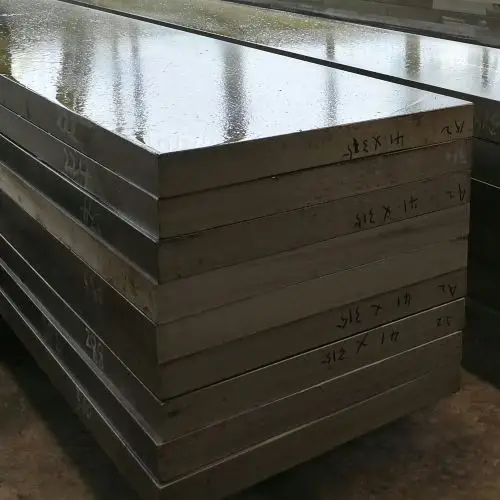
A2 | 1.2363 | SKD12
Air-hardening cold-work tool steel for better dimensional stability, wear resistance, edge retention, dies, gauges, and precision tools.
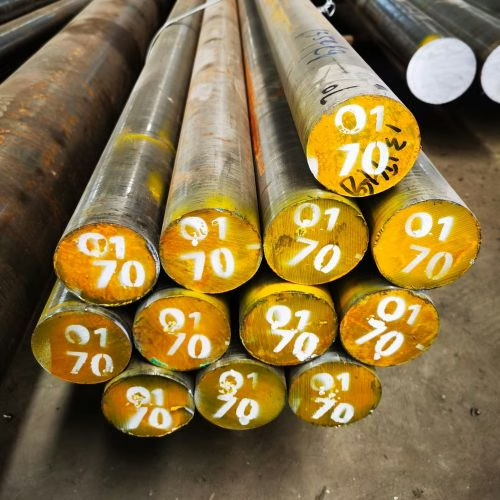
O1 | 1.2510 | SKS3
Oil-hardening cold-work tool steel for economical tooling, easier machining, simple punches, short runs, and general low-volume tools.
A2 vs O1 Tool Steel Quick Selection Guide
| Requirement | Better Choice | Reason |
|---|---|---|
| Better dimensional stability after heat treatment | A2 | Air hardening reduces quench stress and movement. |
| Complex geometry, sharp corners, or uneven sections | A2 | Lower cracking and distortion risk than oil-quenched O1. |
| Longer production runs | A2 | Higher wear resistance improves tool life. |
| Better abrasion resistance | A2 | Higher chromium content forms more wear-resistant carbides. |
| Easier machining before hardening | O1 | Simpler alloy design gives better machinability. |
| Lower initial material and processing cost | O1 | O1 is usually more economical to buy and process. |
| Simple tools with short or medium production runs | O1 | Performance is usually sufficient when wear demand is not severe. |
| Precision dies, gages, or tight-tolerance tools | A2 | Better size control after hardening. |
| Heavy shock or severe impact loading | Neither is ideal | Use a shock-resisting grade such as S7. |
| High-temperature tooling | Neither is ideal | Use hot-work grades such as H11 or H13. |
A2 vs O1 Tool Steel Equivalent Grades and Standards
A2 and O1 are both cold-work tool steels, but they belong to different hardening types. A2 is an air-hardening medium-alloy tool steel. O1 is an oil-hardening low-alloy tool steel. Both grades are covered under ASTM A681.
| Standard System | A2 Tool Steel | O1 Tool Steel |
|---|---|---|
| UNS | T30102 | T31501 |
| DIN / W.-Nr. | 1.2363 | 1.2510 |
| JIS | SKD12 | SKS3 |
| B.S. | BA2 | BO1 |
| AFNOR | Z100CDV5 | 90MWCV5 |
| SS14 | 2260 | 2140 |
Equivalent grades help buyers compare materials across different standards. The final substitution should still be checked against chemical composition, heat-treatment requirements, hardness target, and the order specification.
A2 vs O1 Chemical Composition Comparison
The main difference between A2 and O1 is alloy design. A2 contains much higher chromium and molybdenum, which improve hardenability, wear resistance, and dimensional stability. O1 has a simpler alloy system with higher manganese and some tungsten, making it easier to machine and more economical to process.
| Element | A2 (%) | O1 (%) |
|---|---|---|
| Carbon | 0.95–1.05 | 0.85–1.00 |
| Chromium | 4.75–5.50 | 0.40–0.60 |
| Molybdenum | 0.90–1.40 | ~0 |
| Manganese | ≤1.00 | 1.00–1.40 |
| Tungsten | ~0 | 0.40–0.60 |
| Vanadium | 0.15–0.50 | ≤0.30 |
A2’s higher chromium content forms more wear-resistant carbides and supports deeper hardening during air cooling. Its molybdenum content also improves hardenability and reduces the need for severe quenching.
O1 has fewer alloy carbides and relies more on carbon and oil quenching to reach hardness. This makes it easier to machine before hardening, but it is more sensitive to distortion and cracking during heat treatment.
A2 vs O1 Property Comparison
A2 and O1 reach 58–62 HRC in cold-work tooling. Performance differences stem from wear resistance, machinability, dimensional stability, and hardening behavior.
| Property | A2 | O1 |
|---|---|---|
| Hardening type | Air hardening | Oil hardening |
| Working hardness | 58–62 HRC | 58–62 HRC |
| Wear resistance | High | Medium |
| Toughness | Medium–High | Medium |
| Dimensional stability | Excellent | Good |
| Machinability | Moderate, around 60% | High, around 90% |
| Through hardening | Deep | Limited, around 63 mm |
A2 gives better wear life and size control after hardening; O1 is easier to machine before heat treatment.
For simple tools, O1 may deliver enough performance at a lower cost. For precision tools or longer production runs, A2 is usually the safer choice.
Heat Treatment and Dimensional Stability
Heat treatment is one of the most important differences between A2 and O1. The key is which steel can reach the required hardness with acceptable distortion, cracking risk, and dimensional movement.
| Factor | A2 | O1 | Practical Impact |
|---|---|---|---|
| Austenitizing temperature | 950–970°C | 788–816°C | A2 needs tighter heat-treatment control. |
| Quenching method | Air | Oil | O1 has higher thermal stress. |
| Distortion | Very low | Moderate | A2 is better for precision parts. |
| Cracking risk | Low | Higher | O1 is more sensitive to geometry. |
| Section capability | Larger sections | Limited, around 63 mm | O1 is not ideal for thick parts. |
| Tempering | Double temper | Single temper | A2 normally needs stricter process control. |
A2 cools more slowly in air, so it usually has lower internal stress and better dimensional stability. This is useful for tools with complex geometry, sharp corners, thin sections, uneven sections, or tighter size requirements.
O1 needs oil quenching for hardness, which creates strong thermal gradients. O1 is thus more prone to movement or cracking during hardening, especially in tools with thick or uneven geometry.
Both steels should be tempered immediately after quenching. Delayed tempering increases the risk of cracking and reduces the reliability of heat treatment.
Application and Cost-Based Selection
A2 and O1 overlap in some uses but are chosen for different reasons. The better choice depends on volume, geometry, accuracy, machining cost, and heat-treatment risk.
| Tooling Condition | Better Choice | Reason |
|---|---|---|
| Precision dies | A2 | Lower movement during hardening. |
| Gages | A2 | Better dimensional stability. |
| Blanking dies for longer runs | A2 | Better wear resistance and tool life. |
| Forming tools | A2 | Better stability and wear resistance. |
| Coining tools | A2 | Better size control under pressure. |
| Simple cutting tools | O1 | Easier machining and finishing. |
| Simple punches | O1 | Lower production cost. |
| General low-volume tooling | O1 | Cost-effective when wear demand is moderate. |
| Short production runs | O1 | Lower initial cost is usually more important. |
| Medium to long production runs | A2 | Longer tool life can reduce downtime and rework. |
O1 lowers initial cost through lower price and machinability. A2 may lower long-term cost by increasing tool life and reducing rework.
| Cost Factor | A2 | O1 |
|---|---|---|
| Raw material cost | Higher | Lower |
| Machining cost | Higher | Lower |
| Heat-treatment risk | Lower | Higher |
| Tool life | Longer | Shorter |
| Maintenance | Lower | Higher |
| Rework risk | Lower | Higher |
| Best cost advantage | Long-term production cost | Initial manufacturing cost |
Choose O1 when the tool is simple, production volume is low, and machining cost is the primary concern. Choose A2 when distortion, downtime, tool wear, or rework can increase the real production cost.
When Not to Use A2 or O1
| Scenario | O1 | A2 | Better Direction |
|---|---|---|---|
| Complex geometry | Not recommended | Suitable | A2 is safer than O1. |
| High-volume production | Not recommended | Suitable | A2 gives better wear life. |
| Large sections | Not recommended | Use with caution above 125–150 mm | Check hardening capability and section size. |
| High temperature above 260°C | Not suitable | Not suitable | Consider H11 or H13. |
| Heavy impact or shock loading | Limited | Limited | Consider S7. |
| Severe abrasion or very long runs | Limited | Better, but may not be enough | Consider D2. |
O1’s limits include distortion, cracking, section size, and moderate wear resistance. A2 is limited when high impact strength, hot strength, or abrasion resistance is needed.
Final Selection Summary
Choose A2 for stability and wear
A2 is the better choice for precision tools, complex shapes, longer production runs, and applications where distortion control and wear resistance matter.
Choose O1 for simple, economical tools
O1 is the better choice for simple tools, short runs, easier machining, and lower initial cost.
Do not choose between A2 and O1 only by hardness. Both can achieve similar working hardness, but A2 offers better stability and wear life, while O1 offers better machinability and a lower upfront cost.
Need A2 or O1 tool steel for cold-work tooling?
Aobo Steel supplies A2 and O1 tool steel for dies, punches, blades, gauges, and precision tooling. Share your application, size, quantity, and tolerance for a practical material suggestion.
Email [email protected] · Tel and WhatsApp +86 180 6294 5370
Related pages
Related comparisons: A2 vs D2 · A2 vs H13 · A2 vs S7 · O1 vs D2 · O1 vs O2
Reference pages: A2 tool steel properties · A2 steel composition
Grade families: Tool steel grades · Tool steel material finder
Composition and hardness figures are typical published values for A2 / 1.2363 / SKD12 and O1 / 1.2510 / SKS3. Confirm the exact range against the mill certificate for the delivered lot.