
D2 vs 4140 Steel: How to Choose the Right Material
Use D2 tool steel for wear-critical cold-work tooling such as dies, punches, shear blades, slitting knives, and forming tools. Use 4140 alloy steel for load-bearing mechanical parts, including shafts, gears, axles, bolts, fixtures, and machine components.
For tooling surfaces that wear out, D2 is usually the better choice. For structural or mechanical parts that fail by impact, fatigue, bending, or torsion, 4140 is usually safer.
D2 Tool Steel Available from Aobo Steel
Aobo Steel supplies D2 tool steel for wear-resistant cold-work tooling.
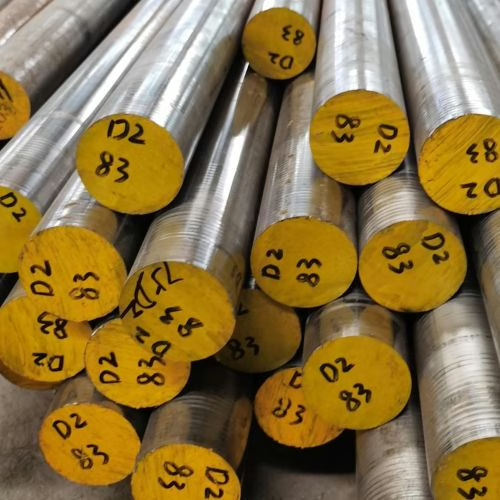
D2 | 1.2379 | SKD11
High-carbon, high-chromium cold-work tool steel for long-run dies, punches, shear blades, slitting knives, forming tools, and abrasive wear surfaces.
D2 is harder and more wear-resistant, but it is also more brittle. 4140 is tougher and easier to machine, but it cannot match D2 in abrasive wear resistance. Choose based on part function, loading, wear, and failure risk.
Quick Selection Table
| Requirement | Better Choice | Reason |
|---|---|---|
| Abrasive wear resistance | D2 | High carbon and chromium form hard wear-resistant carbides. |
| Edge retention | D2 | Better for cutting, shearing, and forming edges. |
| Long-run tooling | D2 | Longer tool life when wear controls failure. |
| High cold-work tooling hardness | D2 | Commonly used around 58-62 HRC. |
| Compressive tooling load | D2 | High hardness and compressive strength support tooling pressure. |
| Impact resistance | 4140 | Better toughness and ductility. |
| Fatigue resistance | 4140 | Better for rotating and cyclic-loaded parts. |
| Torsion and bending load | 4140 | More suitable for dynamic mechanical stress. |
| Shafts, gears, axles | 4140 | Designed for load-bearing mechanical parts. |
| Fixtures and support parts | 4140 | Easier to machine and more economical. |
| Lower machining cost | 4140 | Better machinability and fabrication flexibility. |
| Structural welding or fabrication | 4140 | More practical than D2 for welded or fabricated parts. |
International Grade Equivalents
D2 and 4140 are both AISI designations. The same alloys are produced under different grade names in other standards. When sourcing internationally, verify chemical composition against your specification and request a mill test certificate confirming actual chemical analysis.
| Standard | D2 Equivalent | 4140 Equivalent |
|---|---|---|
| AISI/SAE | D2 | 4140 |
| DIN/EN | 1.2379 / X153CrMoV12 | 1.7225 / 42CrMo4 |
| JIS | SKD11 | SCM440 |
| GB | Cr12Mo1V1 | 42CrMo |
| BS | BD2 | 708M40 |
| AFNOR | Z160CDV12 | 42CD4 |
| UNS | T30402 | G41400 |
D2 and its equivalents are cold-work tool steels. 4140 and its equivalents are structural alloy steels. They are not interchangeable. Do not specify 42CrMo4 or SCM440 as a substitute for 1.2379 or SKD11 in abrasive wear tooling applications.
Chemical Composition and Effects
D2 has higher carbon and chromium, providing stronger wear resistance. 4140’s lower carbon and alloy levels improve toughness, ductility, machinability, and fatigue resistance.
| Element | D2 Tool Steel (% wt) | 4140 Alloy Steel (% wt) | Effect on Performance |
|---|---|---|---|
| Carbon (C) | 1.40-1.60 | 0.38-0.43 | D2 reaches higher hardness and forms more carbides. 4140 keeps better toughness and ductility. |
| Chromium (Cr) | 11.00-13.00 | 0.80-1.10 | D2 gains much stronger wear resistance. 4140 uses chromium mainly for hardenability. |
| Molybdenum (Mo) | 0.70-1.20 | 0.15-0.25 | Supports hardenability in both steels. D2 also uses Mo to improve tempering response and wear performance. |
| Manganese (Mn) | <=0.60 | 0.75-1.00 | 4140 uses higher Mn to support hardenability and processing. |
| Silicon (Si) | <=0.60 | 0.15-0.35 | Supports strength and deoxidation, but it is not the main performance driver in either steel. |
| Vanadium (V) | <=1.10 | Not usually specified | D2 gains additional carbide strength and wear resistance. |
| Phosphorus (P) | <=0.030 | <=0.035 | Controlled as an impurity element. |
| Sulfur (S) | <=0.030 | <=0.040 | Controlled as an impurity element. |
D2’s carbon, chromium, and vanadium give it superior wear resistance. 4140’s simpler alloy design makes it tougher and easier to machine, and better for load-bearing parts.
Mechanical Behavior Comparison
| Property | D2 Tool Steel | 4140 Alloy Steel |
|---|---|---|
| Typical hardness | 58-62 HRC after heat treatment | 28-34 HRC, quenched and tempered |
| Wear resistance | Excellent | Moderate |
| Edge retention | High | Moderate |
| Toughness | Low | High |
| Ductility | Very low | Better |
| Fatigue resistance | Limited for dynamic load | Better |
| Compressive strength | Very high | Moderate to high |
| Machinability | Poorer | Better |
| Grindability | More difficult | Easier |
| Welding suitability | Not recommended for normal tooling use | More practical with proper control |
| Common failure risk | Chipping or brittle fracture | Wear, deformation, or fatigue failure |
D2 works well as a wear surface but performs poorly as a shaft, gear, axle, or impact-loaded component.
4140 works well as a mechanical part, but wears faster when used as a cutting, shearing, or abrasive tooling surface.
Heat Treatment Difference
D2 is usually selected for high hardness, wear resistance, and dimensional stability after heat treatment. It is an air-hardening cold-work tool steel, so distortion is usually lower than that of steels that require liquid quenching.
Quench and temper 4140 to balance strength, toughness, and fatigue resistance. Do not aim for D2-level hardness; toughness is the priority.
| Aspect | D2 Tool Steel | 4140 Alloy Steel |
|---|---|---|
| Hardening type | Air hardening | Usually oil or liquid quenching |
| Main heat treatment goal | Wear resistance and hardness | Strength and toughness |
| Typical hardness after treatment | 58-62 HRC | 28-34 HRC, varies with tempering temperature |
| Typical use direction | Cold-work tooling | Mechanical parts |
| Distortion tendency | Relatively lower | Higher than D2 in liquid quenching |
| Tempering purpose | Reduce brittleness and stabilize hardness | Adjust strength and toughness balance |
| Heat treatment risk | Brittleness, retained austenite, cracking | Poor toughness if improperly treated |
For D2 tooling, final performance depends strongly on hardness, tempering condition, retained austenite control, and edge support.
For detailed information about D2 heat treatment, see our D2 tool steel heat treatment guide.
Machinability and Fabrication
4140 is easier to machine, weld, and fabricate. This makes it more practical for mechanical parts, fixtures, support components, prototypes, and short-run tooling.
D2 is more difficult to machine and grind because of its high carbide content. This increases tool wear, finishing time, grinding difficulty, and total processing cost.
| Processing Factor | D2 Tool Steel | 4140 Alloy Steel |
|---|---|---|
| Machinability | Low | Moderate to good |
| Grinding difficulty | High | Lower |
| Welding | Not recommended for normal tooling use | Possible with proper control |
| Fabrication flexibility | Limited | Better |
| Processing cost | Higher | Lower |
D2 should be used when its wear resistance justifies the higher machining and grinding costs. If wear is not the main problem, 4140 is often the more economical choice.
For cutting parameters and machining suggestions, see our D2 tool steel machining guide.
Can D2 and 4140 Replace Each Other?
D2 and 4140 rarely replace each other, as they serve different functions.
Can D2 Replace 4140?
No. D2 should not be used for shafts, gears, axles, bolts, drive shafts, pump parts, or other dynamically loaded components. These parts need toughness, ductility, and fatigue resistance. D2 may be harder than 4140, but it is more likely to crack or fail under shock or cyclic loading.
D2 may replace 4140 only when the part serves as a tooling surface, and abrasive wear has become the primary failure mode. Examples include some brake tooling, backup blocks, support tooling, or cold-work tooling components where wear life matters more than toughness.
Can 4140 Replace D2?
Only in short-run or low-wear tooling. 4140 can be used for prototypes, fixtures, support blocks, backer plates, drilling jigs, and low-volume tools where wear is not severe. It is easier to machine and usually cheaper to process.
For long-run blanking, punching, slitting, shearing, or abrasive cold-work tooling, 4140 normally wears too fast.
Cost and Processing Difference
D2 usually has higher raw material and processing costs. 4140 usually has a lower initial cost and better machinability.
| Cost Factor | D2 Tool Steel | 4140 Alloy Steel |
|---|---|---|
| Raw material cost | Higher | Lower |
| Machining cost | Higher | Lower |
| Grinding cost | Higher | Lower |
| Heat treatment sensitivity | Higher | Moderate |
| Fabrication flexibility | Lower | Higher |
| Tool life under abrasive wear | Better | Lower |
| Best cost case | Long-run wear tooling | Mechanical parts and short-run tooling |
4140 is often available in normalized, annealed, or quenched-and-tempered conditions, depending on the supplier and application. This can reduce the number of machining or heat-treatment steps for mechanical parts.
D2 is usually supplied in an annealed condition for machining. To achieve typical cold-work tooling hardness, it typically requires a final heat treatment after rough machining. Vacuum heat treatment is commonly preferred for precision tooling to control oxidation, distortion, and final hardness.
For mechanical parts, fixtures, prototypes, and support components, 4140 is usually more economical.
For long-run tooling, D2 may reduce total cost by extending tool life, reducing regrinding, and keeping dimensions stable over a longer production cycle.
Choose 4140 if wear is not severe. Choose D2 if longer wear life justifies the higher processing cost.
When Not to Use D2 or 4140
| Application Condition | Avoid D2 | Avoid 4140 |
|---|---|---|
| Shafts, gears, axles, and dynamic parts | Yes | No |
| Shock or impact loading | Yes | Usually no |
| Repeated bending or torsion | Yes | No |
| Fatigue-loaded mechanical parts | Yes | No |
| Structural welding | Yes | Usually no |
| Long-run abrasive tooling | No | Yes |
| Cutting or shearing edge retention | No | Yes |
| High cold-work tooling hardness | No | Yes |
| Strict wear-based dimensional stability | No | Yes |
| Low-cost prototype or fixture | Usually yes | No |
Do not use D2 when toughness and fatigue resistance are most important.
Do not use 4140 when abrasive wear or edge retention is critical.
Practical Selection Examples
| Application | Recommended Steel | Reason |
|---|---|---|
| Blanking die | D2 | Wear resistance and edge retention are important. |
| Punch | D2 | High hardness and compressive strength are useful. |
| Slitting knife | D2 | Edge retention and wear resistance control tool life. |
| Shear blade | D2 | Better for abrasive cutting and shearing conditions. |
| Shaft | 4140 | Requires toughness, fatigue resistance, and torsional strength. |
| Gear | 4140 | Better for dynamic loading and fatigue resistance. |
| Axle | 4140 | Needs ductility and load-bearing reliability. |
| High-strength bolt | 4140 | Better balance of strength and toughness. |
| Fixture | 4140 | Easier to machine and usually more economical. |
| Backer plate | 4140 or D2 | 4140 for support, D2 only if wear is severe. |
| Short-run brake tooling | 4140 or D2 | 4140 for cost, D2 for longer wear life. |
| Long-run cold-work tooling | D2 | Better tooling life under abrasive wear. |
Final Selection Summary
Choose D2 for wear-critical tooling
D2 is best for abrasive wear, edge retention, high cold-work hardness, and dimensional loss failures in dies, punches, shear blades, slitting knives, and forming tools.
Choose 4140 for load-bearing parts
4140 is best when the part fails by impact, fatigue, bending, torsion, or structural loading, especially in shafts, gears, axles, bolts, fixtures, and machine components.
D2 and 4140 serve different applications. D2 is best for wear-critical tooling; 4140 is best for load-bearing parts.
Need D2 tool steel for wear-critical tooling?
Aobo Steel supplies D2 tool steel for dies, punches, shear blades, slitting knives, and other abrasive cold-work tooling. Share your size, quantity, tolerance, and application to receive a practical supply suggestion.
Email [email protected] · Tel and WhatsApp +86 180 6294 5370
Related pages
D2 comparisons: D2 vs M2 · D2 vs O1 · D2 vs A2 · D2 vs DC53 · D2 vs D3 · D2 vs 440C · D2 vs S7
Reference pages: Tool steel forging temperatures
Grade families: Tool steel grades · D-series tool steels · Tool steel material finder
Composition ranges, hardness figures and heat-treatment temperatures are typical published values for D2 / 1.2379 / SKD11 and 4140 / 42CrMo4. Confirm the exact range against the mill certificate for the delivered lot.