Tahmini okuma süresi: 7 dakika
Önemli Çıkarımlar
- H13 vs A2 tool steel highlights two different types of tool steels: H13 is a hot-work steel, while A2 is a cold-work steel.
- H13 performs well at high temperatures, up to 700°C, whereas A2 operates best below 200°C.
- H13 excels in toughness but has lower wear resistance, while A2 has greater wear resistance but reduced toughness.
- Heat treatment affects both steels; H13 requires multiple tempering cycles for optimal performance, while A2 is typically tempered at lower temperatures.
- Applications differ significantly: H13 is used for die-casting and forging, while A2 is favored for mass production and cold-forming dies.
İçindekiler
H13 vs A2 tool steel: What is the difference between H13 Ve A2 steel? In modern manufacturing, tool steel is an indispensable core material as a specialized, high-quality steel. Tool steel maintains its cutting and forming capabilities at extreme temperatures after quenching and tempering. When our customers select materials for complex operating conditions, we typically recommend evaluating them across three core dimensions, which constitute the three critical factors of tool steel performance: wear resistance, toughness, and hot hardness.
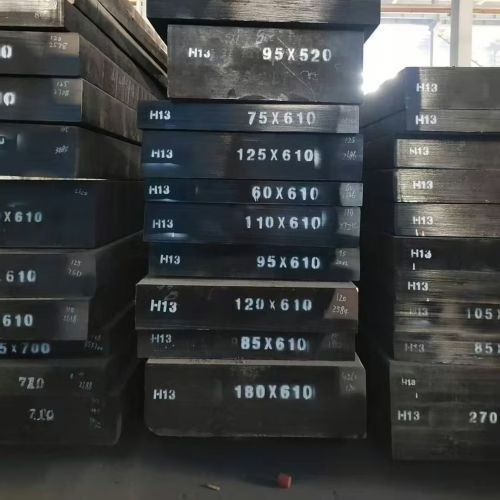
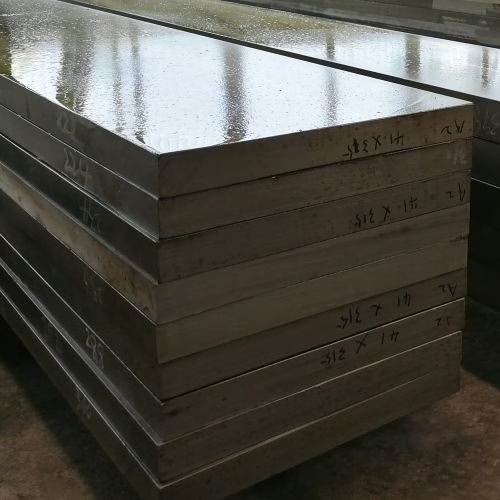
Within the AISI (American Iron and Steel Institute) standard system, H13 and A2 are two highly representative foundational steel grades, yet their application scenarios are entirely distinct. H13 (1.2344), as a sıcak iş takım çeliği, is primarily used in high-temperature environments. It exhibits outstanding resistance to thermal fatigue and is widely employed in die-casting molds. Conversely, A2 is an air-hardening soğuk iş takım çeliği, designed for conditions at room temperature.
Defining the Operational Environment: Hot Work vs. Cold Work
In selecting tool and die steels, H13 and A2 are often used as typical reference points. The most fundamental difference between H13 and A2 lies in their operating temperatures. H13 maintains its strength at high temperatures, withstanding instantaneous temperatures up to 700°C (1300°F). Of course, H13 also has a temperature limit. Beyond 650°C (1138°F), the strength of H13 material begins to decline. To extend the material’s service life, it is recommended to use higher-purity ESR (Electroslag Remelting) H13 material. A2, on the other hand, is only suitable for ambient temperature environments, with typical operating temperatures below 200°C (400-500°F).
Composition and Mechanical Property Comparison
| Sembol | H13 Tool Steel(%) | A2 Takım Çeliği (%) |
| C | 0.32 – 0.45 | 0.95 – 1.05 |
| Cr | 4.75 – 5.50 | 4.75 – 5.50 |
| Ay | 1.10 – 1.75 | 0.90 – 1.40 |
| V | 0.80 – 1.20 | 0.15 – 0.50 |
| Si | 0.80 – 1.20 | 0,50 (Maksimum) |
| Mn | 0.20 – 0.50 | 1.00 (Maksimum) |
| P | 0,03 (Maksimum) | 0,03 (Maksimum) |
| S | 0,03 (Maksimum) | 0,03 (Maksimum) |
In the world of tool steels, no single material is perfect. Material selection is fundamentally a trade-off between three core properties: wear resistance, toughness, and hot hardness.
- Toughness. On a toughness rating scale of 1-9 (lowest to highest), H13 rates 9 while A2 rates 5. If your tooling must withstand severe impacts or operate under complex stresses, toughness is the primary consideration. H13 has a lower carbon content and typically achieves a hardness of 40-50 HRC. The low carbon content minimizes the formation of unsolved carbides, thereby enhancing H13’s impact resistance. In contrast, A2 exhibits moderate toughness. To meet hardness requirements in cold-working applications, A2 increases its carbon and carbide content, boosting its hardness but partially reducing its toughness.
- Wear Resistance. On a wear resistance rating scale of 1-9 (lowest to highest), H13 is rated 3, while A2 is rated 6. Wear resistance typically correlates directly with carbon content and the quantity of hard carbide particles in the steel. A2 contains higher carbon. This high carbon content forms abundant hard carbides, giving it significantly superior room-temperature wear resistance compared to H13. Due to its lower carbon content, H13 lacks sufficiently large primary carbide particles to resist abrasive wear. While its vanadium content provides some assistance, it cannot compete with cold-worked steel in a pure wear resistance comparison.
- Red hardness. On the red hardness rating scale of 1-9 (lowest to highest), H13 is rated 6, and A2 is rated 5. While ordinary steel rapidly softens and deforms above 500–550°C, H13 maintains high hardness and strength even at elevated temperatures. A2 lacks the alloying elements necessary to resist high-temperature softening, limiting its application to cold-working environments.
Heat Treatment and Manufacturing Characteristics
Material selection is only the first step; the ultimate performance of tools and dies is often determined by the heat treatment process. Both H13 and A2 are air-hardening, deep-hardening steels that harden by air cooling. Compared to oil or water quenching, air hardening induces minimal thermal stress and poses the lowest risk of deformation. According to some data sources, H13 and A2 exhibit extremely minimal dimensional expansion after proper heat treatment, approximately 0.001 mm/mm.
During tempering, the processes for H13 and A2 steel differ significantly. H13 is a secondary hardening steel, and it is recommended to perform at least two tempering cycles, or even triple tempering. Multiple tempering cycles not only relieve residual stresses but also promote carbide precipitation, resulting in exceptional red hardness and thermal fatigue resistance. A2 steel exhibits a secondary hardening peak around 510°C. However, in cold-working applications, high-temperature resistance is typically unnecessary; instead, sufficient hardness and wear resistance are required. In practice, to achieve high hardness in A2 steel, a lower tempering temperature of 230°C is commonly employed. High-temperature tempering is considered only when extremely high toughness is required or to eliminate retained ostenit.
In terms of machinability, with 1% carbon tool steel set as the 100-point benchmark, H13 in the tavlanmış state has a machinability score of approximately 70 points. Similarly, the A2 score in the annealed state is about 60 points. Machining accounts for a significant portion of tool-and-die manufacturing costs. Therefore, machinability is a critical factor that cannot be overlooked.
Uygulamalar
- H13 Takım Çelik Uygulamaları: Genel sıcak iş uygulamaları, basınçlı döküm kalıpları (alüminyum, çinko ve magnezyum için), plastik enjeksiyon kalıp takımları ve dövme takımları için yaygın olarak kullanılır. Alüminyum, magnezyum, çelik, bakır ve pirinç için sıcak ekstrüzyon kalıpları için uygundur. Ayrıca sıcak iş için delgeçler, deliciler ve mandrellerde de kullanılır. İşlenmiş boşluklar için kalıp çeliği olarak kullanılabilir ve ESR rafine işleminden sonra yüksek cilalı plastik kalıplar için önerilir. Ayrıca, yüksek sıcaklıklarda yumuşamaya karşı direnci ve orta tokluğu nedeniyle havacılıkta yüksek gerilimli yapısal parçalar için de kullanılır.
- A2 Tool Steel: A general-purpose air-hardening tool steel with a wide range of tooling applications. Commonly used for blanking and piercing dies in mass production. Also used for cold-forming dies, coining dies, drawing and lamination dies, thread-rolling dies, shear and slitter blades, and forming rolls. It’s a good choice for intermediate-service cold-work tools and dies. It can be used for small molds and inserts, and is preferred for large dies due to low distortion during ısıl işlem. Sometimes used as an alternative to hot-work steels for hot shearing tools and dies used in the hot extrusion of zinc.
Karşılaştırma Özeti
| Özellik | H13 Takım Çeliği | A2 Takım Çeliği |
| Birincil Uygulama | Sıcak iş uygulamaları (örneğin; döküm, dövme, ekstrüzyon). | Soğuk iş uygulamaları (örneğin, kesme, şekillendirme, çekme). |
| Aşınma Direnci | High abrasion resistance. Better than S-series but generally less than D-series. Suitable for long production runs on thin- or medium-thickness stock. | Yüksek aşınma direnci. S serisinden daha iyi, ancak genellikle D serisinden daha az. İnce/orta kalınlıktaki malzemelerde uzun üretim serileri için uygundur. |
| Sertlik | Mükemmel darbe dayanımı ve iyi tokluk; yüksek şok direnci onu çoğu sıcak iş operasyonu için tercih edilir kılar. | Hava sertleştirmesi sırasında minimum kalıntı gerilmeler ve minimum/hiç bozulma olmaz. |
| Sıcak Sertlik | Çok yüksek; yüksek sertliğini (örneğin, 540 掳C'de ~52 HRC) ve yüksek sıcaklıklarda dayanıklılığını korur; mükemmel tavlama direnci (ikincil sertleştirme). | High abrasion resistance. Better than S-series but generally less than D-series. Suitable for long production runs on thin- or medium-thickness stock. |
| Sertleştirilebilirlik | Derin sertleştirme, hava sertleştirme. | Derin sertleştirme, hava sertleştirme. |
| Boyutsal Kararlılık | Hava sertleştirmesi sırasında minimum kalıntı gerilmeler ve minimum/hiç bozulma olmaz. | Sertleşmede minimum hareket ve düşük çarpılma, çatlamaya karşı yüksek güvenlik. |
| İşlenebilirlik | Sertleştirilmiş durumda iyi. Tavlanmış derecesi: 1% karbon çeliğine (W1) kıyasla 70%. | Kolay işlenebilirlik. Tavlama derecesi: 1% karbon çeliğine (W1) kıyasla 60-65%. |
| Tipik Sertlik | Pres döküm için normal çalışma sertliği: 44°C'dir. Darbe dayanımı için: 40°C'dir. 2070 MPa'nın (300 ksi) üzerine kadar ısıl işleme tabi tutulabilir. Söndürülmüş haldeki sertliği ~53 HRC'dir. | Normal çalışma sertliği: 58-60 HRC. Söndürülmüş sertlik ~64 HRC. |
In essence, H13 is engineered for severe high-temperature environments, prioritizing hot hardness and strong impact resistance, whereas A2 is a versatile cold-work steel that excels in wear resistance and dimensional stability for room-temperature operations. If you are having trouble deciding between these two materials, please get in touch with us for professional advice.