
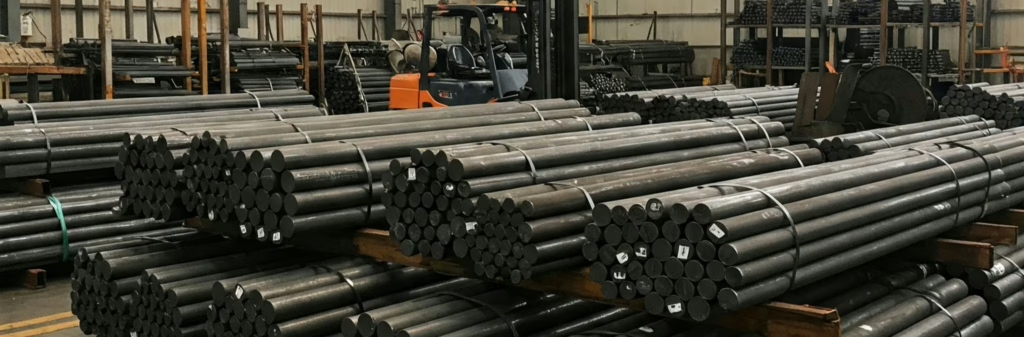
In the metalworking industry, whether it’s shearing blades, blanking dies, cutting tools, slitting knives, or piercing needles, material selection directly determines tool life, production efficiency, and ultimately operational costs.
As the thickness of the stock material increases, the stress on the cutting edges of tools and dies rises exponentially. This demands that tool steel possess high wear resistance and sufficient toughness to ensure the dies remain free from wear and chipping during prolonged punching and shearing operations, and to resist fracturing or breaking under high-impact loads.
Primary Performance Criteria for Shear Steels
Shearing tools are high-stress cutting and forming operations. Some customers ask us: “Why do my shears dull so easily? Why do my punches wear out quickly?” From a microstructural perspective, shear failure essentially involves the slip of crystals within the material under immense shear stress. To counter this phenomenon, material selection must prioritize excellent wear resistance and toughness.
1. Wear Resistance
For shear blades, wear resistance refers to the ability to maintain the original cutting edge profile and dimensional accuracy. During shearing, tool edges endure immense pressure and abrasive forces, causing surface deformation and material erosion. Once microscopic dimensional changes occur at the cutting edge, the tool rapidly dulls, leading to increased burrs and product defects. Therefore, tools must exhibit excellent wear resistance in such applications. The key to enhancing wear resistance lies in increasing the tool’s surface hardness.
2. Toughness and Fracture Resistance
In shear-die failure cases, wear failure occurs gradually, whereas fracture represents a sudden, catastrophic failure. Shear tools used for heavy cuts or for processing thick plates must possess exceptional toughness. Without sufficient toughness, chipping and die cracking occur rapidly.
However, as tool steel gains in wear resistance and hardness, its toughness often diminishes. High-carbon steels like D2, while wear-resistant, become brittle when processing extremely thick plates or subjected to severe impacts. To address chipping and cracking, it is generally necessary to select steel grades with lower carbon content and greater toughness.
3. Hot Hardness
In actual production, it is often not the tools or dies that wear out first, but rather a decrease in hardness due to overheating, or deformation during heat treatment that renders the mold unusable. Therefore, the selection of tool and die steel may also need to consider hot hardness. This refers to the steel’s ability to maintain high hardness and resist temperleme softening even in high-temperature environments.
Selection of Steels for Cold Shearing Operations
High-Production/High-Wear Applications
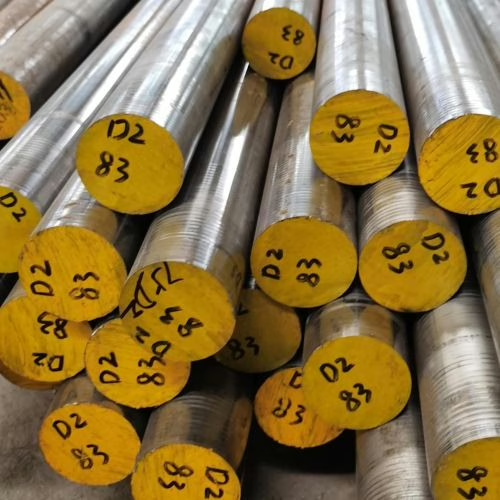
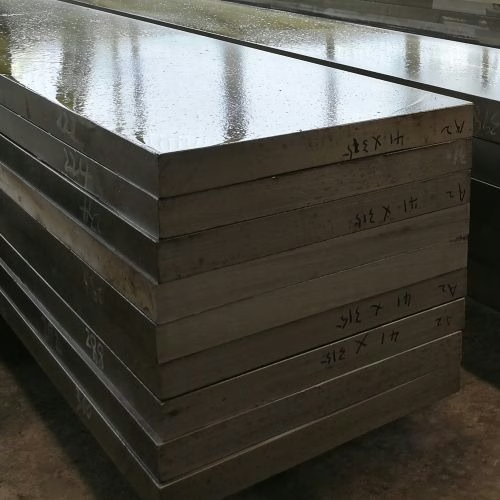
When cold shearing thin or medium-thickness stock in high-volume production, tool steel options include D2 (1.2379) and A2 (1.2363).
D2 takım çeliği is a high-carbon, high-chromium steel. Its microstructure is filled with large, blocky carbides of exceptional hardness, providing effective resistance to high-intensity wear. Through ısıl işlem, D2 can achieve a hardness of 61–63 HRC, representing the highest level of hardness and wear resistance among soğuk iş takım çelikleri.
A2 takım çeliği is a medium-alloy air-hardening steel. It offers superior toughness compared to D2, is less prone to chipping, and carries lower heat treatment risks than D2, with virtually no distortion or cracking. A2 is used for complex-shaped shear blades with high aspect ratios. During ısıl işlem, A2 exhibits exceptional dimensional stability, showing almost no distortion or cracking.
Moderate Production/Shock-Resisting Applications
In cutting operations, not all materials being processed are delicate and compliant. When dealing with heavy stock or scrap—which is often composed of mixed materials and irregular shapes—tools and dies endure not just friction, but impact loads measured in tons.
Under these operating conditions, continued use of high-hardness steels such as D2 often leads to chipping or catastrophic failure. In such cases, you need the higher toughness of the S series or L6.
The S Series (Shock-Resisting) tool steel has a reduced carbon content. Compared to high-carbon steels prioritizing high wear resistance, the S Series sacrifices some hardness in exchange for exceptional toughness, ensuring it does not fracture under severe impact. S1, S2, S5, and S7 grades from the S Series are widely used in cold-shearing heavy billets or scrap shears. During scrap shearing operations, blades frequently endure lateral squeezing and instantaneous high impacts due to the unpredictable shape of the material being cut. S1, S2, S5, and S7 tool steels maintain blade integrity under these conditions.
In addition to the specialized S series, L6 (1.2714/SKT4) tool steel is another commonly used low-alloy oil-hardening steel. It is used for industrial cutting tools that require high toughness. This steel is a versatile tool material, particularly suited for applications that demand a certain level of hardness without excessive brittleness.
Selection of Steels for Hot Shearing Operations
In hot shearing and trimming applications for hot forgings, die steel must not only exhibit wear resistance comparable to that of cold shearing but also possess red hardness. For these conditions, H-Series sıcak iş takım çeliği is the superior choice.
For the vast majority of heavy-duty hot-shearing applications, mold surface temperatures typically remain below 480°C (900°F), permitting the use of water-cooled systems. Within this temperature range, chromium-based hot-work steels (H11, H12, H13) represent suitable choices.
When cutting temperatures are extremely high, cooling water cannot be used, or the mold experiences severe heat buildup due to prolonged contact with red-hot billets, causing mold temperatures to exceed 480°C, ordinary chromium-based steels begin to soften. At this point, tungsten-based hot-work steels with extremely high tungsten content (H21, H25) are the appropriate choice. The tungsten element confers exceptional thermal stability to the steel.
When cutting extremely hard, tough materials, or when demanding exceptionally long tool life, conventional tool steels may wear out or soften rapidly. In such cases, high-speed steel (HSS) with outstanding red hardness and ultra-high wear resistance is the optimal choice.
In our common understanding, high-speed steel (HSS) is typically used to manufacture continuous cutting tools such as drill bits and milling cutters. High-speed steel is a complex iron-based alloy containing high concentrations of carbon, chromium, vanadium, molybdenum, or tungsten. These alloys maintain a sharp cutting edge even when subjected to high temperatures generated by high-speed friction.
M2 (1.3343) is a versatile molybdenum-based high-speed steel. It combines toughness with wear resistance. In extreme conditions, M2 serves as an upgraded replacement for D2 and is commonly used in high-frequency shearing applications such as sawing and milling.
M4 and T15 contain higher levels of carbon and vanadium, offering superior wear resistance and hardness compared to M2, making them suitable for high-wear applications.
M42 (1.3247) is a cobalt-containing super-hard high-speed steel. Through heat treatment, M42 can achieve a hardness of 70 HRC.
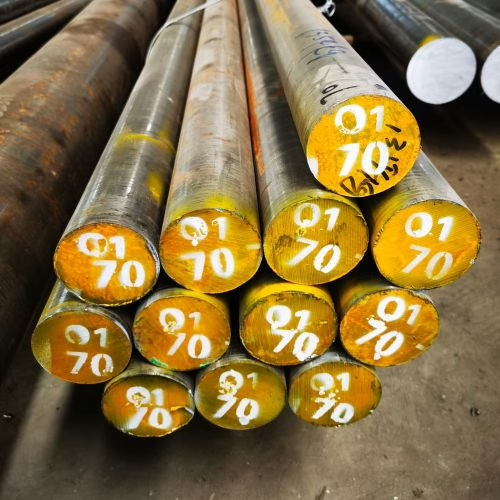
Reference Data
Makaslar için Çelik Seçimi
| Uygulamalar | Çelik |
| Şok koşulları, sıcak veya soğuk kesme; ağır bölümlerin sıcak kesilmesi | S2 |
| S5 | |
| S1 | |
| Şok koşulları, sıcak veya soğuk kesme, ağır bölümlerin sıcak kesilmesi için | H11 |
| A8 | |
| İnce veya orta kalınlıktaki stoklarda yüksek üretim için soğuk iş makasları | O1 |
| A2 | |
| D2 | |
| İnce veya orta kalınlıktaki stoklar için uzun kaldırmalı soğuk makaslar; en yüksek aşınma direnci | M3 |
| M4 |
Bu malzemelerin aşınma direnci, tokluğu ve sıcak sertliğine ilişkin verilerin karşılaştırılması
| Çelik Sınıfı | Aşınma Direnci | Sertlik | Sıcak Sertlik |
|---|---|---|---|
| S2 | |||
| S5 | |||
| S1 | |||
| H11 | |||
| A8 | |||
| O1 | |||
| A2 | |||
| D2 | |||
| M3 | |||
| M4 |