Is A2 Steel the Same as 304 Stainless Steel?
No — A2 tool steel is NOT the same as 304 stainless steel.
The confusion exists because the term “A2” is used in two completely different standards:
- In tool steels, A2 is an air-hardening cold work tool steel
- In ISO 3506, A2 refers to austenitic stainless steel equivalent to Type 304
These are fundamentally different materials with completely different functions.
Why the Confusion Happens
The designation “A2” is not a universal material name. Its meaning depends entirely on the standard being referenced.
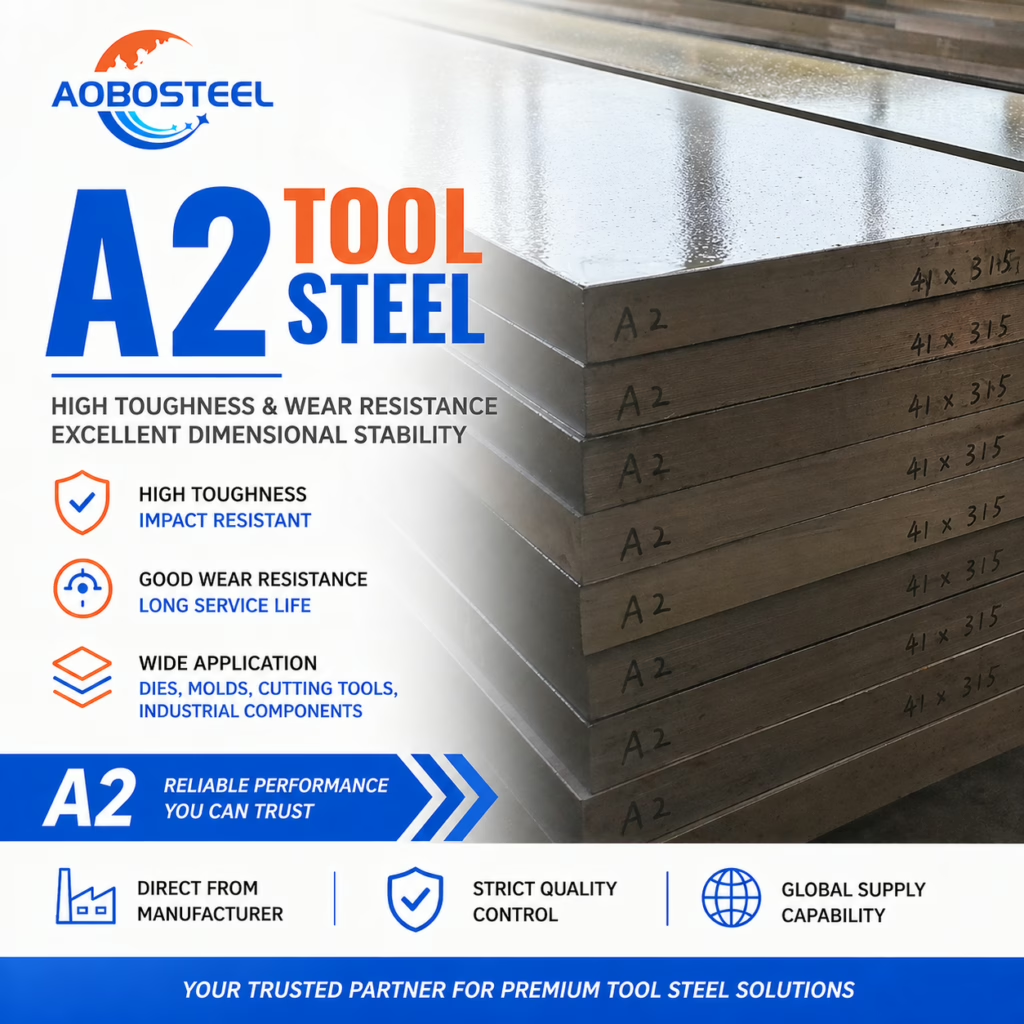
A2 Tool Steel (AISI System)
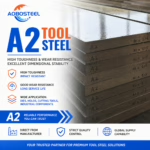
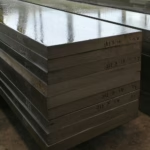
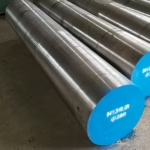
In the AISI classification system, A2 is a cold work tool steel designed for wear resistance and dimensional stability.
It is typically used in applications such as dies, punches, and cutting tools where resistance to wear is critical.
It is not suitable for corrosion-resistant environments.
A2 Stainless Steel (ISO 3506)
In ISO 3506, A2 refers to austenitic stainless steel used for fasteners, equivalent to Type 304.
This designation commonly appears as A2-70 and A2-80.
Type 304 stainless steel is characterized by:
- Approximately 18% chromium and 8% nickel
- Austenitic structure
- Stable corrosion resistance in general environments
Key Differences Between A2 Tool Steel and 304 Stainless Steel
| Property | A2 Tool Steel | 304 Stainless Steel (ISO A2) |
|---|---|---|
| Material Type | Cold work tool steel | Austenitic stainless steel |
| Primary Function | Wear resistance | Corrosion resistance |
| Hardness | High after heat treatment | Moderate |
| Corrosion Resistance | Low | High |
| Typical Applications | Dies, cutting tools | Fasteners, equipment |
How to Avoid Material Selection Errors
The term “A2” must always be interpreted within its standard context.
In tool steel specifications, it refers to a wear-resistant material.
In fastener standards, it refers to corrosion-resistant stainless steel.
Using the wrong material can result in:
- Premature wear or failure
- Unexpected corrosion
- Incorrect processing routes
Final Insight
“A2” only has meaning within a defined standard system. It cannot be interpreted independently.
Material selection should always be based on function, service environment, and specification requirements rather than name similarity.